On the Role of Static Analysis in Operating System Checking and Runtime Verification
A RESEARCH PROFICIENCY EXAM PRESENTED
BY
ABHISHEK RAI
STONY BROOK UNIVERSITY
Technical Report FSL-05-01
May 2005
Abstract of the RPE
On the Role of Static Analysis in Operating System Checking and
Runtime Verification
by
Abhishek Rai
Stony Brook University
2005
Software inevitably contains bugs. For certain classes of software
like operating systems, reliability is a critical requirement. Recent
research has shown that several commodity operating systems, even
after careful design and extensive testing, still contain a number of
bugs.
Methods for automated detection of bugs in software can be classified
into (1) static methods, (2) formal verification, and (3) runtime
checking.
In this paper, our focus is on verifying critical properties of large
and complex software like OSs, one such property being correctness of
memory accesses. For this purpose, we evaluate both static checking
techniques and runtime checking techniques, and present our
observations.
Static checking is useful because the cost of repairing a bug
increases along the software development lifetime. Bugs
discovered and fixed early result in significant cost savings.
We evaluate a representative set of existing static checking techniques
on the basis of soundness, precision, and usefulness in checking
large software like the Linux kernel.
We also cover the related problem of deriving property rules
for automated checking.
Static checking though useful, cannot in general catch all possible
bugs in C programs, without producing false alarms. Consequently,
it is mostly a best-effort exercise to find some, but not
all bugs.
However, memory access checking is too critical to be trusted to
static techniques. We introduce a survey of existing bounds checking
techniques. In particular, we show that it is possible to classify
the wide range of existing bounds checking techniques into a single
hierarchy. We evaluated existing techniques based on
soundness, performance, and usability.
A software bounds checking framework for the Linux kernel is
introduced and evaluated.
We observe that existing static checking methods have limited
coverage in detecting bugs. For verifying the correctness of critical
program properties like memory accesses, runtime checking is
necessary. However, runtime methods by themselves are not very useful
due to performance reasons. Hence, we conclude advocating static
analysis for use in runtime checking systems.
To my family
Contents
1 Introduction
2 Overview
2.1 Why Is C Not Enough
2.1.1 Types of Bugs
2.1.2 The Nature of Software Bugs
2.2 Bug Detection Techniques
2.2.1 Formal Verification
2.2.2 Runtime Checking
2.2.3 Static Checking
2.2.4 Issues and Trade-Offs in Static Checking
3 Static Analysis Survey
3.1 Annotation-Based Techniques
3.1.1 Lint
3.1.2 LCLint
3.1.3 Splint
3.1.4 Extended Static Checking
3.1.5 Cqual
3.2 Tool-Based Techniques
3.2.1 PREfix
3.2.2 ESP
3.2.3 Abstract Interpretation: ASTREE
3.2.4 SLAM
3.2.5 Metacompilation
3.3 Language-Based Approaches
3.3.1 Cyclone
3.3.2 Vault
3.3.3 Comparison of Cyclone and Vault
3.3.4 MOPS
4 Automated Deduction of Checking Rules
4.1 The Need for Automated Deduction
4.2 Invariant Inference using Predicate Abstraction
4.2.1 Inferring Loop Invariants
4.2.2 Predicate Abstraction
4.3 Invariant Inference for Annotation Based Checkers: Houdini
4.4 Runtime Methods for Inferring Invariants
4.5 Bugs as Deviant Behavior: Combining Static Analysis and Invariant Inference
4.6 Extracting Finite State Models from Code
4.6.1 Metal Based System for Flash
5 Case Study: Memory Bounds Checking
5.1 The Nature of Memory Bugs
5.2 Static Methods for Detecting Memory Bugs
5.2.1 Archer
5.3 Runtime Checking for Detecting Memory Bugs
5.3.1 Purify
5.3.2 Safe-C
5.3.3 Decoupling Computation and Bounds Checking
5.3.4 Backward-Compatible Extensions to Safe-C
5.3.5 Cash: Hardware Assisted Bounds Checking
5.4 Bounds Checking for the Linux kernel
5.4.1 KBCC
5.4.2 Mudflap
5.4.3 Kernel Code Electric Fence
5.5 Performance Evaluation
5.5.1 Kefence
5.5.2 KBCC
6 Static Analysis as a Means for Facilitating Runtime Checking
6.1 Static Analysis for Bounds Checking
6.1.1 CCured
6.1.2 Static Analysis in BCC
6.2 Static Analysis for Instrumentation of Code
6.2.1 Aspect-Oriented Programming
6.2.2 Source Code Instrumentation in Aristotle
7 Conclusions and Future Work
7.1 Static Checking
7.2 Runtime Bounds Checking
7.3 Future Work
List of Figures
2.1 Example of an Application Level Protocol that should be satisfied in program code
3.1 Static checkers plotted along the two dimensions coverage and effort
5.1 Bounds checking overhead for ReiserFS with Am-utils and Postmark
6.1 Architectural overview of the Aristotle system
List of Tables
3.1 Table showing how Cyclone handles various types of errors
3.2 Feature comparison of static checkers
5.1 A two-level classification for runtime bounds-checking technique
5.2 Table showing the differences between capability-based and availability-based runtime bounds checking
\LARGE{{Acknowledgments}}
Acknowledgments
I would like to thank my advisor, Professor Erez Zadok, for his
constant support for this project. The vision of this project
shaped during several insightful discussions with him. Besides,
he taught me several interesting and useful research practices
along the way. Sean Callanan, Radu Grosu, Scotta Smolka, Scott
Stoller, and Annie Liu provided an excellent forum for discussion
and development of ideas related to this project.
My committee members, Tzi-cker Chiueh and Scott Stoller, were
generous of their time and provided helpful input and comments
on the work. Amit Sasturkar and Rahul Agarwal provided valuable
feedback on some ideas in this paper.
I thoroughly enjoyed the company of members of File Systems and
Storage Laboratory, Sean Callanan, Gopalan Sivathanu, Charles Wright,
Avishay Traeger, and Nikolai Joukov during the course of this project.
Kapil Kumar, Mahadev Konar, Susanta Nanda, Sumit Jain, and Mohit Gupta
have made my stay in Stony Brook entertaining and pleasant. And,
friends from A1 are just as cherished today, on a daily basis, as they
were years before.
Finally, I would like to thank my family, papa, mummy, montu,
and didi for everything.
This work was partially made possible thanks to NSF CAREER award
EIA-0133589, NSF award CCR-0310493, and HP/Intel gifts numbers
87128 and 88415.1.
Operating system reliability has become more important than ever.
Users trust their computers with important data, and OS failures can
have catastrophic effects, like data loss, resource unavailability,
and at the very least, frustrated users. Moreover, commodity
operating systems are increasingly being used in enterprise scenarios
to create large scale computing and storage clusters. But commodity
operating systems are still unreliable. Recent techniques for
automated debugging of some commodity operating systems have
discovered numerous bugs [47].
Manual checking of code is not enough. For one, it is both
error-prone and time consuming, and secondly, humans easily get
overwhelmed by complexity. This motivates the need for automation of
the checking process. Moreover, the wide variety of bugs found in
these systems call for innovative techniques for automated bug
detection. Existing techniques can be classified into static methods,
model checking, and runtime checking. In this report we study
applications of static techniques for automated debugging and analysis
of software. In particular, we consider two different ways to apply
static analysis to software. First, we present a survey of static
checking techniques for automated debugging of OS kernels. Second, we
study the use of static analysis and instrumentation for runtime
checking of OS kernels.
Static methods have significant benefits over other approaches to
automated analysis of software. In comparison to runtime checking,
static analysis has three main advantages. First, static analysis
does not need to actually execute the software. Thus bugs can be
discovered and fixed early during the development process. Second,
software that is statically checked does not suffer from the
performance overhead of runtime checking. Third, static analysis
covers all code uniformly; unlike runtime checking techniques, bugs on
rarely executed code paths also get discovered. Although model
checking techniques share some of these merits over runtime checking,
they are rendered effectively intractable for large software systems
due to scalability problems and the lack of a formal specification or
model of the system.
We believe that static analysis of code has great potential in helping
improve software quality. Static checking of code is just one of its
possible applications. Additionally, static analysis of code can be
combined with other techniques like model checking and runtime
checking to produce even more powerful checking systems. For example, one can
first check software statically, and then leave the rest for runtime
verification. Similarly, one can combine static analysis with model
checking to automatically discover predicates using model checking
heuristics and then check them using static analysis [16].
We demonstrate the amalgamation of static analysis and runtime
checking through a memory bounds checking system we have developed for
the Linux kernel. Memory bound overrun bugs often have serious
consequences. They can result in security breaches, program
misbehavior and worse still, they can silently damage the system. It
is all the more acute for OS kernels where memory bugs can lead to
security breaches and permanent data loss.
We have ported two open source memory bounds checking systems into the
Linux kernel, and with the help of static techniques, have
significantly cut down their performance overheads. Additionally, we
have made significant modifications to reduce the number of false
positives, and support concurrency.
The rest of this paper is organized as follows.
In Section 2 we present a classification for bug
detection techniques and synthesize the basic ingredients for static
checking.
In Section 3 we present a survey of a static
checking techniques.
Section 4 motivates the need for automated
deduction of checking rules and presents a quick survey.
Section 6 generalizes static checking and
advocates using it as a means for enhancing the effectiveness of
runtime checking. We present some of our own work in this section.
Section 5 focuses on memory related bugs
in software. We present a survey of existing techniques and present
our own work in this field.
We finally conclude in Section 7 and identify future
avenues of research in this field.
In this section we derive the basic thesis of automated bug finding
in software. We first examine the nature of bugs in systems software.
Based on these bugs, we then present the design space for automatic
static checking techniques with particular emphasis on techniques for
checking large complex software written in C, like OS kernels.
Finally, we compare static checking with other methods of detecting
bugs in software, like formal verification and runtime checking.
2.1 Why Is C Not Enough
Since its very inception, C has been the de-facto language for systems
programming. In fact, systems programming and C have evolved side by
side ever since C's introduction in the 1970s. Like other trends in
computing industry, this was not necessarily designed to be that way,
but this is how things turned out to be. So far, C has suited well
for the requirements of a systems programming language. In general,
any systems programming language is required to provide the following
features.
- Control over low-level data representation
- Explicit memory management
- Performance, and "transparency" of performance: performance
characteristics of a C program should directly manifest in the source
code (e.g., language features like automatic garbage collection make
runtime overhead of a program unpredictable).
C satisfies all these requirements to the extent mandated by
traditional systems. However, as the scale and complexity of systems
increases, systems design as it is known today is getting increasingly
overwhelmed by complexity and bugs. This can be attributed to two
basic deficiencies in the design of the C language.
First, C is too permissive. As a result, compilers cannot catch all
possible bugs. For example, C tries to give programmers much
control over memory layout of data structures; and, it allows them to
control the lifetime of program resources (like memory). This is
partly by design: C does not enforce strong semantics at the language
level (type system). Also, at the time C was conceived, program
analysis was not advanced enough to develop a strongly typed but
flexible language. In any case, the design of C served well in
accommodating a wide range of programming styles and implementation
requirements. But, it also opens up the possibility of programming
bugs. The default type checking done by C compilers is weak and
misses many bugs. It is ultimately left to the developer to exercise
their prudence to produce "good" error-free code.
The second serious drawback of C is its lack of extensibility. There
is a large gap between the semantics of a typical systems program and
the simple rules enforced that the C compiler tries to enforce. As a
result, the compiler is bound to miss bugs. They may not be
"language" bugs, but they are bugs nevertheless.
Consider the following example. Synchronization
primitives are a common ingredient of systems programs. In the
context of the Linux kernel, it is required that the spin_lock
function is called, only when the lock is not already held. Similarly,
the spin_unlock function should be called while the lock is held.
This property can be conveniently depicted using a state diagram
as shown in Figure 2.1.
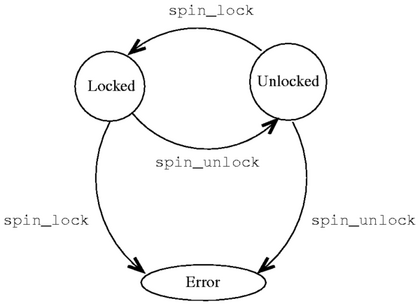 Figure 2.1: Example of an Application Level Protocol that should be
satisfied in program code. During normal operation, the system can
be in one of two states: Locked or Unlocked. Calls to
spin_lock and spin_unlock cause transitions between these
states. Any other transition results in an error.
However, the C language as such, provides no support for incorporating
application level semantics into compile-time checking. The developer
has to validate higher level properties of their code using
alternative methods.
Code inspection is still the most widely
exercised code checking technique (after compilation). But humans can
easily get overwhelmed by complexity beyond a few hundred lines of
code. As a result, manual checking is error-prone and time consuming.
Moreover, manual checking has poor incremental returns: as different
components of the system evolve and rules and invariants change, it is
quite an art trying to maintain such code. Local changes applied to
only a small part of the program often end up breaking other,
seemingly unrelated parts of the code. Despite all these challenges,
C has no built-in support for language-extensions for checking program
conformance to higher level properties.
Figure 2.1: Example of an Application Level Protocol that should be
satisfied in program code. During normal operation, the system can
be in one of two states: Locked or Unlocked. Calls to
spin_lock and spin_unlock cause transitions between these
states. Any other transition results in an error.
However, the C language as such, provides no support for incorporating
application level semantics into compile-time checking. The developer
has to validate higher level properties of their code using
alternative methods.
Code inspection is still the most widely
exercised code checking technique (after compilation). But humans can
easily get overwhelmed by complexity beyond a few hundred lines of
code. As a result, manual checking is error-prone and time consuming.
Moreover, manual checking has poor incremental returns: as different
components of the system evolve and rules and invariants change, it is
quite an art trying to maintain such code. Local changes applied to
only a small part of the program often end up breaking other,
seemingly unrelated parts of the code. Despite all these challenges,
C has no built-in support for language-extensions for checking program
conformance to higher level properties.
2.1.1 Types of Bugs
It is not possible to give a complete listing, or even a useful
classification of all possible bugs. In this section we discuss some
common bugs and their causes. This discussion will help us classify
bug detection techniques in the next section.
Let us consider a simple bug. The following piece of C code tries to
copy the string "hello world" into the array arr.
fn()
{
  char arr[11];
  strcpy(arr, "hello world");
}
One can make two observations regarding this code. First, the
allocated space for arr is too small to accommodate the entire
string in it. Secondly, strcpy does not detect and handle this
situation. As is obvious, this operation will cause data to be
written beyond the limits of the array arr. The result could be
a program crash, or misbehavior due to memory corruption, or, no
visible effect at all. One can take two points from this example:
- simple static checking can detect some potentially dangerous
bugs.
- knowledge of procedure interfaces would be useful, e.g., knowing
that strcpy will not check the operation for bounds overflow.
We now present some common types of bugs.
Memory Errors
These are probably the most common bugs in C programs. Memory access
bugs, especially memory buffer overruns have caused much grief to IT
industry. We classify existing techniques for detecting memory bugs
in Section 5. We also consider in detail
the case of runtime bounds checking.
Inconsistent Interfaces
In large complex systems, which have several smaller components making
up the whole system, it is important that individual components have
strictly enforced interfaces. When this is not the case, the software
can behave unpredictably. This problem can be related to the issue of
automatically enforcing higher-level system specifications.
Traditionally, software written in C has not had access to checkable
specifications. For example, Jass or JML for Java.
Violation of Temporal Properties
Imperative programs are essentially temporal artifacts. There is
often a prescribed temporal ordering of operations. For example, lock
before unlocking, etc. Violations of temporal properties can result
in synchronization errors (deadlocks, race conditions), memory leaks,
use after free (dereferencing of pointers which have already been
freed), etc.
Bugs due to Software Development Processes
Software development processes introduce several bugs. One of the
nastier ones is regression bugs. As code evolves over time,
it is more difficult to maintain. First, developers leave and with
them goes ad-hoc undocumented knowledge about the code. Second, as
new code is added, components may get out of sync with each other, or
existing code may be broken. This is very much the case when software
specifications are not tightly coupled with the code, and the
developer is responsible for ensuring compatibility. For example,
checkable interface specifications, or annotation-based systems can
help prevent such regressive digressions (Section
3).
This paper does not address problems arising from incorrect
synchronization in concurrent programs, including problems like data
races, atomicity violations, and deadlocks. These problems have been
extensively studied in literature, and static, dynamic, as well as
hybrid techniques addressing these problems have been developed
[23,30,56,51,52,112].
2.1.2 The Nature of Software Bugs
In recent times, a lot of research effort has been focused at
detecting and studying bugs in operating system kernels. This is no
surprise considering the possible implications of buggy operating
systems. The two leading operating systems of today,
Linux [47,137] and Microsoft
Windows [16] have received much scrutiny from researchers
developing automated static checking systems. Also, these methods
have been successful in finding numerous bugs.
Chou et al. studied of bugs in the Linux
kernel [32]. The bugs they report were found using
their static checking system which we discuss in Section
3.2.5. In particular, they made the following notable
observations about bugs in the Linux kernel which justify some of the
claims we have made above:
- Bug distribution is much higher in device drivers than the core
kernel. This is because the core kernel undergoes much greater
scrutiny and runtime testing than device drivers. However, a buggy
device driver is just as likely to crash a kernel.
- Long and complex functions have a higher number of bugs per line
of code. Thus, programming in C does not handle complexity very well.
- Bug distribution between files is logarithmic: few files have
most bugs while most files have none or few bugs. This is probably
due to the fact that thousands of developers are involved in kernel
development, and they have very different backgrounds-they all not
be trusted with producing completely bug-free code.
- Some bugs in the Linux kernel had lived for a couple of years
before they were detected. This serves to demonstrate that
traditional methods do not achieve good coverage.
Apart from the issue of programming errors, another grossly mishandled
case is the absence of a unified mechanism for graceful recovery from
errors (exceptions). Since error detection is often postponed to
runtime (instead of being pointed out at compile time), the system is
usually not well equipped to handle every possible error case. In the
worst case, this could cause the whole system to crash, leading to
loss of data or service. The cases in which the system misbehaves
without explicitly crashing are equally disagreeable.
The approaches we discuss in this section try to address some or all
of these issues in different ways. Existing methods for detecting or
preventing memory bugs can be classified into language based
approaches, static analysis, and runtime checking techniques
2.2 Bug Detection Techniques
Bug detection is a very broad field. The central thesis of this paper
is that static detection of bugs can be useful; however, they cannot
completely verify large complex systems. For such systems, static
checking is best combined with runtime checking for catching all bugs.
Static checking is useful because the cost of repairing
a bug increases along the software development time-line. An early
discovery can result in a substantial saving. This paper demonstrates
that static analysis can be very useful in these regards.
Of course, it would be a better idea to avoid bugs altogether (better
programming practices); however, in the absence of completely sound
bug avoidance, having redundant checking is better than producing
buggy programs.
Apart from "discovering" bugs, it would be very useful if the bug is
detected as close to its origin in the code as possible.
This makes for easy fixing of the bug. For instance, run-time memory
checking facilities can also detect NULL pointer dereferences.
However, they usually do not provide detailed history of events
leading to the NULL pointer, a good static checker can in many
cases backtrack in its analysis state to provide more useful information.
We now compare static checking with alternative bug detection
strategies for the case of checking OS kernels.
2.2.1 Formal Verification
Twenty years ago, Rushby outlined the difficulties in verifying secure
kernels [108] and suggested a physical separation of OS
components. Neumann et al. built comprehensive
mechanisms for proving the security of the PSOS operating system
[96], a hierarchically-structured OS written in a
strongly-typed language. Later works focused on compartmentalization,
boundary protection, and some verification of OSs such as Mach
[9,62], Pebble [59], EROS
[117], DEOS [101], and Fiasco
[68,124]. In the Kit project, Bevier tried to prove
the correctness of an OS using theoretical techniques [21].
As security concerns grew with the Internet, the U.S. Department of Defense
released The Orange Book [41], which serves as a
"bible" for evaluating secure systems. Arbaugh showed the life-cycle of
system vulnerabilities, emphasizing the importance of early discovery,
disclosure and fixing of bugs, and then releasing patches
[12]. They also showed how important it was for the
security and integrity of computer systems, to be able to verify each
component and layer independently [11].
Model checking of OSs has been used to detect specific problems within OS
components.
Pike et al. used the SPIN [20] verification system to
detect a certain subtle race condition in Plan 9 [103].
More recent efforts seek to extract models from OS source code
[14,17,87,48], with
an emphasis on checking data-independent properties of device drivers
and network protocols, and to apply model checking directly to software
[36,61,121,80,93].
However, model checking techniques do not trivially extend to
operating systems that were not designed with verifiability as a goal
(e.g., Linux). Model checking such a huge system is impractical for
two reasons: (1) lack of a complete model or specification for the
system, (2) state space explosion. Nevertheless, several static
checking techniques use ideas from the model checking world
[16,36,42].
2.2.2 Runtime Checking
Most runtime external checking of systems is incidental. For example,
the Bonnie tool is a program that exercises the memory (VM) and cache
subsystems of the OS by creating very large files and then randomly
reading and writing parts of them [24,35].
Similarly, file-system developers test a new or modified file system
by compiling a large package (such as the kernel source itself) inside
a mounted instance of the new file system
[100,134,136,135].
The POSIX standard specifies a common set of system calls for OSs
[70] and also offers a standard description of how to
test code for POSIX compliance [69].
In the fields of security and intrusion detection, wrappers are used
to guard software interfaces by monitoring inputs, outputs, and
sequences of operations
[126,18,19,114,85,115,133].
Chiueh showed how to protect loadable kernel modules from each other
on x86-based OSs such as Linux [29]. We also propose
to wrap system calls and monitor them for compliance, but our wrappers
are generated from formal specifications of the system-call
interfaces. Wrapper mechanisms with an overhead of no more than
1-2% are possible
[18,19,134,136,135].
Our monitoring is intended not only for security, but for any deviant
behavior.
Runtime checking in tools such as the Bounds-Checking Gnu C (BCC)
[25], Purify [106] and Insure++ [79], perform
runtime monitoring for memory corruptions; e.g., running off of the
end of a string in C. We discuss this in detail in Section
5. Run-time monitoring can also detect
potential race conditions [113] and atomicity
violations [83,52]. Also, some
methods have combined runtime checking with static checking to obtain
robust property checking. Specifically, the static checking
properties validates all that can be verified statically, the
remaining checks are left to be checked at runtime.
2.2.3 Static Checking
The central tenet of static checking is that many abstract program
restrictions map clearly to source code constructs. Static checking
is based on the science of program analysis. Program
analysis offers static techniques for predicting safe and computable
approximations to the set of values or behaviors arising dynamically
at run-time when executing a program on a computer
[97]. However, program analysis-including
finding possible run-time errors-is undecidable: there is no
mechanical method that can always answer truthfully whether programs
may not exhibit runtime errors. When faced with this mathematical
impossibility, the alternative has been to apply certain techniques
that simplify the overall program analysis problem into more tractable
problems. There are four basic approaches to program analysis:
- Data Flow Analysis treats programs as graphs: the nodes
are the elementary blocks and the edges describe how control might
pass from one elementary block to another. For example, for handling
the problem of reaching definitions, the standard approach is
to coin mathematical abstractions for the role of edges in the graph
and solve them using a set of equations. Symbolic execution as used
in PREfix and SLAM (Section 3.2) are types
of data flow analysis.
- Constraint-Based Analysis verifies global properties by
solving a set of local constraints generated from the program text.
Constraint generation from program text has the effect of separating
specification from implementation. Constraints hide implementation
details and pave the way for tractable, structural proofs. There are
two basic constraint theories: data flow analysis and type-inference.
In Section 3.1.5 we present Cqual which is a
constraint-based type inference system.
- Abstract Interpretation (AI) maps programs into more
abstract domains [74,8]. This makes
analysis more tractable and potentially useful for checking. The
theory of AI differs from other approaches, it is a general
methodology for calculating analyses rather than specifying them and
then relying on a posteriori validation. For AI to be effective, it
imposes a constraint on the nature of the abstraction and the
concretization functions. This is called the galois
connection and serves to produce a safe over-approximation analysis.
ASTREE (discussed in Section 3.2.3) is an example of an
AI-based static checker. In Sections 3.2.4 and
4.2, we use predicate abstraction
[110], which is a special form of abstract
interpretation in which the abstract domain is constructed using a
given set of predicates.
- Type and Effect Analysis is an amalgamation of two
ingredients: an effect system and an annotated type
system. The effect system tells the effect a statement's execution
has. The annotated type system provides the semantics for the effect
system. Type analysis is the most commonly used technique enforced by
compilers for static checking (e.g., the gcc -Wall option).
Type inference (Section 3.1.5) is a useful approach. Most
of the checkers discussed in Section 3 use some
form of strong type enforcement.
Despite the apparent differences, these approaches to program analysis
are equally powerful. There is some commonality among these
approaches. The art of program analysis entails cultivating the
ability to choose the right approach for the right task and in
exploiting insights developed in one approach to enhance the power of
the other. Moreover, one can argue that it is not possible to give a
single clear-cut classification of static checking techniques.
This is because (1) there is a significant overlap in different techniques,
(2) seemingly radical approaches are often equivalent in terms of
program analysis power, and (3) designing good static checkers is
increasingly an engineering problem-innovative implementations
often beat more ambitious but less useful ones.
Nonetheless, for the purpose of discussion, it helps to divide
our subjects into a few classes. In Section 3 we
classify static checking techniques into annotation-based methods, and
tool-based methods. Although this may not be the right choice, it
certainly has the advantage of better capturing the programmer's
imagination.
2.2.4 Issues and Trade-Offs in Static Checking
Before we discuss existing static analysis techniques, it would be
useful to get a taste of common engineering issues and
trade-offs in designing static checkers. We qualify these as
"engineering" because they require a deep knowledge of available
information and a creative intuition for effective handling. The
choices made in handling these issues often have little effect on the
"power" of the static analysis as such, but they often are the
deciding factor in the acceptance of the system.
We present below a listing of the issues and trade-offs we identified.
This is not an exhaustive list. Also, they are mostly orthogonal; in
most cases one can realign one trade-off without disrupting others too
much.
- Soundness and Completeness
It is well known that program analysis-including finding possible
run-time errors-is undecidable. When faced with this mathematical
impossibility, the alternative has been to apply certain techniques
that simplify the overall program analysis problem into more tractable
problems. This approximation invariably results in loss of soundness
or precision. Soundness in the context of static checking is defined
as catching all the bugs in the code. Completeness reflects
that all bugs caught by the checker should be true bugs in
the system and not "false positives." We also use the term
precision to describe completeness in this paper. So, if a sound
analysis is desired, precision has to be sacrificed, and vice versa.
In other words, there is always a soundness-precision trade-off. For
example, the PREfix system (Section 3.2.1) sacrifices
soundness for precision. Imprecise checkers usually generate a lot of
false error notices and separating them from real errors is a
time-consuming process. PREfix takes the approach of analyzing only
some program paths, but it analyzes them well, yielding
precise results. This precision comes at the cost of soundness. The
ASTREE checker (Section 3.2.3) which is based on abstract
interpretation allows the soundness-completeness trade-off to be
adjusted by simply controlling a parameter. This is an interesting
and powerful use of abstract interpretation.
- Annotations vs. External Checking
Someone designing a static checker is invariably faced with this
issue regarding what interface to provide to the programmers: code
annotations or external checking. Whereas annotations are applied as
a layer on top of the program code, external checking can directly
apply to unmodified program code. Annotations provide a fine-grained
specification intermixed with program code. Thus it is tightly bound
to the code and can even double up as a protocol specifications.
Consequently, the likelihood of annotations getting out of sync with
the code (e.g., due to regression) is small. Also, we believe that
due to tight coupling between program code and annotations,
annotation-based systems are more capable of attacking soundness than
external checking systems. External checking systems have some
advantages over annotations. First, annotations have poor
reuse: one has to add them to every place in the code where
they apply. External checkers isolate checking specifications into
modular specifications which can then be uniformly applied to
the program code. Second, users may not favor a tight integration
between checking and program code the way annotations do it, because
tight coupling implies difficulty in migration to different checkers
in the form of rewriting effort.
Third, the annotation effort is usually difficult to predict and
measure in advance at the checker-design stage. For example,
consider the Cqual annotation-based checker (Section 3.1.5).
Its designers initially chose annotations believing that the
annotation overhead will be manageable and will give good returns on
the cost of annotating. However, when Cqual was applied to
increasingly complex programs, it was found to yield a large number of
false error notices. As a result, new annotations were added
to suppress false positives. Thus it is difficult to always predict
the amount of annotation effort needed. However, recent research has
been focused at automatic inference of annotations saving the
programmer from the effort. We discuss one such system, Houdini, in
Section 4.3.
- Scalability
Automated bug detection can potentially be most useful for large
complex programs. However, traditional automated checkers can easily
get overwhelmed with the complexity of these programs. The key is to
design scalable checkers. Consider the case of
interprocedural vs. Intraprocedural analysis. Interprocedural
analysis can potentially discover more bugs, and can be more precise
than intraprocedural analysis. For example, 90% of the errors caught
by the PREfix interprocedural checker (Section 3.2.1)
involve interactions of multiple functions. However,
interprocedural analysis can be very expensive in terms of CPU and
memory requirements. Also, interprocedural analysis may scale
super-linearly with program size. Intraprocedural, possibly flow
sensitive analysis is more tractable. One commonly followed approach
is memoization: maintaining "summaries" of analyzed
functions for possible reuse (Section 3.2.5). Summaries make
interprocedural analysis much more tractable. In fact, systems like
Archer (Section 5.2.1) implement highly scalable
path-sensitive interprocedural analysis by using summaries for
analyzed functions. Note that summaries are mostly used in
conjunction with bottom-up analysis so that any function call
can be replaced by a summary for that function.
- Aliasing
Aliasing is often regarded as the bane of program analysis. Combating
aliasing is a recurrent theme of the checkers presented in this paper.
Static analysis systems that aim to give soundness guarantees
(Section 3.1.5) need to make conservative assumptions about
the presence of aliases. This significantly limits the power of
a static analyzer. A common solution is to allow the programmer to
declare a variable as un-aliased in a certain scope, allowing the
analyzer to aggressively infer properties in that scope without
fearing any aliases.
Chapter 3
Static Analysis Survey
In this section we describe a representative set of existing static
checking systems. We place particular emphasis on the scalability and
the usefulness of the checker. Scalability is important because our
ultimate goal is checking large complex software like OS kernels.
Usefulness has many dimensions: the more bugs a checker finds the more
useful it is, fewer false bug reports, and ease of use by the
end-programmer to easily add custom checks. We classify
static checking techniques into annotation based methods, and tool
based methods. Although this may not be the right choice, it
certainly has the advantage of better capturing the programmer's
imagination.
We conclude this section with a quick analysis of how individual
systems compare against each other.
3.1 Annotation-Based Techniques
Program annotations is the term given to specifying behavioral aspects
of code. For example, the const qualifier in C specifies a
behavioral constraint. Program annotations serve as a useful tool for
automated checking of behavioral aspects of programs. Annotations can
also be viewed as a means for augmenting the semantic and behavioral
content of a program, by specifying additional constraints that the
code must satisfy. Thus, annotations help enforce additional semantic
checking of the program over the default checking performed by the
compiler.
In this section we consider a few annotation-based tools for static
checking. Although this is not in any way a comprehensive listing,
still to the best of our knowledge, it is a representative list of the
state of annotation assisted checking in software.
Lint is probably the oldest static checker (other than the language
compiler) that continues to be widely used today. Lint checks C
programs for a small fixed set of syntax and semantic errors. It
performs simple flow sensitive and type aware checking, but can only
detect violations of basic program properties. In fact, Lint is now
essentially superfluous since many of the checks performed by Lint
have been in GCC for a long time now. However, Lint is of historical
value given the set of checkers that were inspired by it, two of which
are the subject of this section: LCLint and Splint.
Lint is a command-line driven tool with command line arguments for
specifying which of the several checks provided by Lint should be
applied to the program. The annotation support in Lint was introduced
for suppressing false alarms.
One additional feature of Lint is its "code portability" check: when
invoked with the -p option, Lint checks the code for possible
portability issues from its dictionary of known portability problems
[122].
LCLint [49,2] grew out of the Larch Project
at the MIT Lab for Computer Science and DEC Systems Research Center.
It was originally named after LCL [123], the Larch C
Interface Language and Lint.
LCL and Larch
The Larch family of languages [65,92] represent a
two-tiered approach to formal specification. A specification is built
using two language: the Larch Shared Language (LSL), which is
independent of the implementation language, and a Larch
Interface Language designed for the specific implementation language.
An LSL specification defines sorts, analogous to abstract
types in a programming language, and operators, analogous to
procedures. It expresses the underlying semantics of an abstraction.
The interface language specifies an interface to an abstraction in a
particular programming language. It captures the details of the
interface needed by a client using the abstraction and places
constraints on both correct implementations and uses of the module.
The semantics of the interface are described using primitives and the
sorts and the operators defined in LSL specifications. Interface
languages have been designed for several programming languages. LCL
[123] is a Larch interface language for Standard C. LCL
uses a C-like syntax.
LCLint
Much of the difference between Lint and LCLint is that Lint's
annotations are related to minimizing the number of false positives,
whereas LCLint's annotations have more features, only some of which
are used for this purpose. LCLint makes extensive use of annotations
to define behavioral aspects of code and to suppress false positives.
LCLint's annotations were originally derived from a subset of LCL
specifications. Although separate LCL specifications can provide more
precise documentation on program interfaces than is possible with
LCLint annotations, LCLint's designers chose the annotations approach
over separately provided specifications for obvious reasons.
LCLint can detect problems like violations of information hiding;
inconsistent modifications of caller-visible state or uses of global
variables; memory management errors including uses of dead storage and
memory leaks; and undefined program behavior. LCLint checking is done
using simple dataflow analyses and is potentially as fast as a
compiler.
LCLint was designed to run frequently on large programs and hence
checking efficiency and scalability were important requirements. As a
result, LCLint employs a number of simplifications for faster analysis
and ease of use. For example, LCLint does not incorporate
inter-procedural data flow analysis, instead relies on programmer
annotations for adjudging the role of function calls, and loops are
considered identical to if statements for the purpose of the
analysis. Also, LCLint focuses specifically on errors at interface
points. Hence, it only uses weak intra-procedural alias analysis that
infers inter-procedural actions from the annotations.
Splint 3.0.1 [3] is the successor of LCLint version
2.5q. The main changes are support for secure programs (hence the
name Splint) and extensible checks and annotations.
User-defined Annotations
Currently, LCLint users are limited to a pre-defined set of
annotations and associated checking. This works well as long as their
programming style is consistent with the methodology supported by
LCLint (e.g., abstract data types implemented by separate modules,
pointers used in a limited systematic way), but is problematic if they
need to check a program that does not adhere to this methodology. For
example, LCLint provides annotations for checking storage that is
managed using reference counting. An annotation is used to denote an
integer field of a structure as the reference count, and LCLint will
report inconsistencies if new pointers to the structure are created
without increasing the reference count, or if the storage associated
with the referenced object is not deallocated when the reference count
reaches zero. If a program implements reference counting in some
other way (for example, by keeping the reference counts in a separate
lookup table), however, LCLint provides no relevant annotations or
checking. More generally, applications have application-specific
constraints that should be checkable statically. These could include
value consistency requirements, event ordering requirements, and
global constraints. Splint provides extensions to LCLint that address
this problem by supporting user-defined annotations. Programmers have
some freedom to invent new annotations, express syntactic constraints
on their usage, and define checking associated with the user-defined
annotation in different contexts.
3.1.4 Extended Static Checking
ESC/Java [54] descends from the intellectual
tradition of program verification. It is an annotation-based static
checker for Java programs that uses theorem solving of program
predicates to check for correctness. ESC/Java is intermediate in both
power and ease of use between type-checkers and theorem-provers, but
it aims to be more like type-checkers and is lightweight in comparison
with to theorem-provers. This way, the designers of ESC/Java hoped to
make it easy to use by the programmers (like type-checkers) rather
than extraordinarily powerful but so difficult to use that programmers
shy away from it (like theorem-provers). Also, hence the name
"extended static checker."
Figure 3.1 shows the intuitive
placement of "extended static checking" between conventional
type-checking and program verification [54].
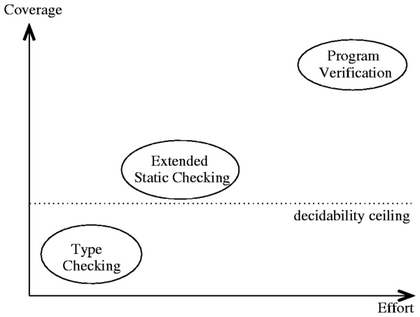 Figure 3.1: Static checkers plotted along the two dimensions
coverage and effort (not to scale). Extended Static Checking as
implemented in ESC/Java is intermediate both in coverage and effort
needed between type-checkers and program verification systems.
At the time ESC was first proposed [42], powerful
static checkers needed programmer assistance for checking. This is
not in agreement with ESC's goal for ease of use and hence ESC does
not require any programmer assistance while checking.
ESC/Java is designed to scale well with code size. It employs modular
checking. Specifically, when checking the body of a function f,
ESC/Java does not examine bodies of functions called by f.
Rather, it relies on the specifications of those functions, as
expressed by annotations. Hence, ESC/Java can check individual
components of a system separately, leading to good scalability.
ESC/Java supports a powerful specification language. The
specification language is the language used to write ESC/Java
annotations. It is composed of one or more specification
expressions, or pragmas. ESC/Java provides a rich
specification language which revolves around these expressions.
ESC/Java expressions can be arbitrary first order logic formulas.
Also, they can be nested or combined like standard Java expressions,
and are type-checked in ways similar to Java code. However, there are
inevitably some differences between them and standard Java syntax.
Also, ESC/Java specifications can be provided in separate files
(.spec files). This is useful when the Java sources they
annotate are unavailable for use by the checker.
ESC/Java checks the first-order logic expressions using the Simplify
automatic theorem prover [38]. First-order is
logic is undecidable, hence no theorem prover can prove it in
polynomial time. Simplify is a best effort theorem prover and tries
to prove or disprove its input till as long as it can before giving
up.
The operation of ESC/Java consists of the following steps:
Figure 3.1: Static checkers plotted along the two dimensions
coverage and effort (not to scale). Extended Static Checking as
implemented in ESC/Java is intermediate both in coverage and effort
needed between type-checkers and program verification systems.
At the time ESC was first proposed [42], powerful
static checkers needed programmer assistance for checking. This is
not in agreement with ESC's goal for ease of use and hence ESC does
not require any programmer assistance while checking.
ESC/Java is designed to scale well with code size. It employs modular
checking. Specifically, when checking the body of a function f,
ESC/Java does not examine bodies of functions called by f.
Rather, it relies on the specifications of those functions, as
expressed by annotations. Hence, ESC/Java can check individual
components of a system separately, leading to good scalability.
ESC/Java supports a powerful specification language. The
specification language is the language used to write ESC/Java
annotations. It is composed of one or more specification
expressions, or pragmas. ESC/Java provides a rich
specification language which revolves around these expressions.
ESC/Java expressions can be arbitrary first order logic formulas.
Also, they can be nested or combined like standard Java expressions,
and are type-checked in ways similar to Java code. However, there are
inevitably some differences between them and standard Java syntax.
Also, ESC/Java specifications can be provided in separate files
(.spec files). This is useful when the Java sources they
annotate are unavailable for use by the checker.
ESC/Java checks the first-order logic expressions using the Simplify
automatic theorem prover [38]. First-order is
logic is undecidable, hence no theorem prover can prove it in
polynomial time. Simplify is a best effort theorem prover and tries
to prove or disprove its input till as long as it can before giving
up.
The operation of ESC/Java consists of the following steps:
- First, ESC/Java loads, parses, and type-checks the files named
on the command line, as well as any other files needed because their
contents are directly or indirectly used by files named on the command
line.
- Next, for each class whose function bodies are to be checked,
ESC/Java generates a type-specific background predicate encoding such
information as subtype relations, types of fields, etc. in the class
to be checked and the classes and interfaces it uses.
- Next, ESC/Java translates each function to be checked into a
logical formula called a verification condition (VC). As an
intermediate step in this translation, ESC/Java produces a command in
an intermediate language [86] based on Dijkstra's
guarded commands. The intermediate language includes commands of the
form assert E, where E is a boolean expression of the
language. An execution of a command is said to "go wrong" if
control reached subcommand of the form assert E when E is
false. Ideally, when a function f is translated into a command
C and then to a verification condition V, the following
three conditions should be equivalent:
- There is no way that f can be invoked from a state
satisfying its specified preconditions and then behave erroneously by,
for example, dereferencing null, violating an assert pragma,
terminating in a state that violates its specified postconditions,
etc.
- There is no execution of C that starts in a state
satisfying the background predicate of f's class and then goes
wrong.
- V is a logical consequence of the background predicate.
In practice, the translation is incomplete and unsound, so there may
be semantic discrepancies between f, C, and V.
Finally, ESC/Java invokes the Simplify [38]
theorem prover, asking it to prove each body's verification given the
appropriate background predicate. If an attempted proof succeeds (or
if Simplify exceeds specified resource limits in attempting the proof,
or if ESC/Java exceeds specified resource limits generating the
verification condition), then ESC/Java reports no warnings for the
body. If the proof fails (other than by exceeding resource limits),
Simplify produces a potential counterexample context, from which
ESC/Java derives a warning message.
Unsoundness and Incompleteness in ESC/Java
ESC/Java is unsound and incomplete and can hence miss errors actually
present in the program it is analyzing. This is inevitable from
ESC/Java's design, since it is meant to be an extended static checker
rather than a program verifier. However, ESC/Java provides pragmas
for the programmer to control the soundness and incompleteness of
checking. Thus users can balance annotation effort, completeness, and
verification time. Here are some known causes of unsoundness in
ESC/Java (taken from the ESC/Java Manual [76]).
- Loops: ESC/Java does not consider all possible
execution paths through a loop. It considers only those that execute
at most one complete iteration (plus the test for being finished
before the second iteration). This is simple, and avoids the need for
loop invariants, but it is unsound. The users can modify ESC/Java's
treatment of loops by using the -loop command-line option to
specify how many loop iterations should ESC/Java consider. We study
methods for automatically inferring loop invariants in Section
4.2.1. Archer (Section 5.2.1) uses symbolic
execution and heuristics to aggressively unroll loops whenever
possible.
- Trusting Pragmas: The assume, axiom, and
nowarn pragmas allow the user to introduce assumptions into the
checking process. ESC/Java trusts them. If the assumptions are
invalid, the checking can miss errors. For example, ESC/Java depends
on programmers to supply monitored and monitored_by
pragmas telling which locks protect which shared variables. In the
absence of such annotations, ESC/Java will not produce a warning when
a routine might access a variable without holding the appropriate
lock.
- Search Limits in Simplify: If Simplify cannot find a
proof or a (potential) counterexample for the verification condition
for a routine within a set time limit, then ESC/Java issues no
warnings for the method, even though it might have issued a warning if
given a longer time limit. If Simplify reaches its time limit after
reporting one or more (potential) counterexamples, then ESC/Java will
issue one or more warnings, but perhaps not so many warnings as it
would have issued if the time limit were larger. There is also a
bound on the number of counterexamples that Simplify will report for
any conjecture, and thus on the number of warnings that ESC/Java will
issue for any routine. Again, these limits can be set by the
programmer.
- Concurrency: Although we do not consider concurrency in
this paper, it is nonetheless an important topic in program analysis
research. Interestingly, ESC/Java assumes that the value of a shared
variable stays unchanged if a routine releases and then reacquires the
lock that protects it, ignoring the possibility that some other thread
might have acquired the lock and modified the variable in the interim.
Here are some causes and consequences of incompleteness in ESC/Java:
- Incompleteness of the Theorem-Prover: The verification
conditions that ESC/Java give to the Simplify theorem prover are in a
language that includes first-order predicate calculus along with some
(interpreted) function symbols of arithmetic. Since the true theory
of arithmetic is undecidable, Simplify is necessarily incomplete. In
fact, the incompleteness of Simplify's treatment of arithmetic goes
well beyond that necessitated by Godel's Incompleteness Theorem. In
particular, (1) Simplify has no built-in semantics for multiplication,
except by constants, and (2) Simplify does not support mathematical
induction. Also, first-order predicate calculus (FOPC) is only
semidecidable-that is, all valid formulas of FOPC are provable,
but any procedure that can prove all valid formulas must loop forever
on some invalid ones. But it is not useful for Simplify to loop
forever, since ESC/Java issues warnings only when Simplify reports
(potential) counterexamples. Therefore Simplify will sometimes report
a (potential) counterexample C, even when it is possible that
more work could serve to refute C.
- Modular Checking: ESC/Java's use of modular checking
causes it to miss some inferences that might be possible through whole
program analysis. However, the designers chose to retain modular
checking in lieu of its scalability benefits.
Cqual (previously Carillon) [57] is an annotation-based
extension to C that uses the power of flow-sensitive
type-state analysis to catch bugs statically. Cqual is an
amalgamation of ideas from type-checking and constraint-based
analysis. The user extends the language type system with
flow-sensitive type qualifiers, which are atomic properties that
refine standard types similar to standard C type qualifiers such as
const. Cqual checks constraint satisfaction on these type
qualifiers inter-procedurally. Cqual's analysis is sound,
meaning that it does not miss a bug, although it may report false
errors (it is incomplete).
Programmers uses Cqual by specifying two things: they augment standard
C code with type qualifiers, and, identify sub-typing relationship
between the type qualifiers. For example, consider the following
program constraint introduced to prevent format string attacks
[116].
Data entered by a user should not directly be used as argument
to printf since the user may be an adversary.
This constraint can be specified in Cqual by introducing two type
qualifiers for character strings: tainted for strings that could
be controlled by an adversary, and untainted for strings that
must not be controlled by an adversary. The sub-typing relationship
between the two qualifiers is denoted as:
untainted < tainted
meaning that untainted is a subtype of tainted, any piece
of code that accepts a tainted argument can be passed an
untainted argument, but not vice versa.
The sub-typing relation is typically specified as a lattice of type
qualifiers with partial-order relations between the qualifiers. CQUAL
has a few built-in inference rules that extend the subtype relation to
qualified types. Using the extended inference rules, CQUAL performs
qualifier inference to detect violations against the type relations
defined by the lattice. Intuitively, Cqual works by converting a
program augmented by type qualifiers into constraints on type
qualifier compatibility, which can be represented graphically. The
problem of checking correctness is then reduced to graph reachability.
Cqual's analysis employs a unique combination of flow-insensitive and
flow-sensitive analysis. It models program state as an
abstract store, which is a mapping from variables to types
(types contain qualifiers). The effect of a program statement on the
state is emulated as a "Hoare logic" type effect with possible
changes in variable types (ALLOC and ASSIGN
operations). This flow-insensitive phase also includes alias analysis
and effect inference. Following this, the flow-sensitive analysis
phase handles flow-sensitive qualifiers and linearity issues for alias
analysis. Finally, even though Cqual's analysis is not
path-sensitive, it does not suffer from false-positives due to
impossible paths. This is because Cqual's constraint satisfaction
logic tries to find at least one way to satisfy the constraints,
rather than finding all possible violations. However, since it does
not do path-sensitive analysis, the error message may not be as
informative (as in PREfix, for example).
One of the key innovations in Cqual is its practical approach to alias
analysis. The general problem in alias analysis is making updates to
one alias visible to others.
Cqual handles this by adding a layer of indirection between pointers
and their types by introducing an abstract location with each
variable. With this change, a variable is associated with an abstract
location, and abstract stores map abstract locations to
qualified types. Thus a type update to an abstract location is
automatically available to other references pointing to that location.
An abstract location is defined as linear if the type system
can prove that it corresponds to a single concrete memory location in
every execution; otherwise, it is non-linear. Updates to linear
locations can arbitrarily change their qualifiers (strong updates).
Updates to a non-linear location result in a unification of qualifiers
(weak update). Locations may be inferred as non-linear even if strong
updates are desired on them (Cqual is sound). Evidently, strong
updates give better opportunities to test qualifier constraints.
Linearity can be reclaimed by using Cqual's restrict keyword (or
equivalently the confine keyword). The expression restrict
x = e1 in e2 introduces a new name bound to the value of e1.
The name x is given to a new abstract location, and among all
aliases of e1 only x and values derived from x may
be used within e2. Thus, the location of x may be linear,
and hence may be strongly updated, even if the location of e1 is
non-linear.
Cqual's scalable, annotation-based analysis has been applied to large
software including the Linux kernel. It discovered several locking
bugs in Linux [57], and has been used to detect
format-string vulnerabilities too [137]. Cqual is
easy to use and provides strong soundness guarantees. However, there
are two problems with Cqual. Firstly, checking pre-written code with
Cqual needs substantial rewriting effort. Secondly, Cqual's
conservative aliasing assumptions may lead to a high number of
false-positives requiring additional annotation effort to suppress
them (restrict operator). Recently, Cqual has introduced automatic
confine inference by the static analyzer to reduce the burden
of aliasing annotations. In fact, it has been observed to apply to
roughly 95% of pre-written C code [10].
Usability
Cqual's design places strong emphasis on usability. Firstly, due to
its unique combination of intra-procedural and inter-procedural
analysis, Cqual is quite scalable. This is further demonstrated by
the number of bugs it has caught in the Linux kernel (4M+ LOC and
counting). Secondly, Cqual is easier to use than some other
annotation-based systems: it needs less annotation-effort, thanks to
automatic inference of type qualifiers. Also, confine-inference has
been shown to work 95% of the time on pre-written code. Thus, one
does not need to add heavy annotations to enforce linearity. Finally,
Cqual is getting ready for mainstream usage: it currently presents the
analysis results using Program Analysis Mode, an Emacs-based
GUI. However, there are two concerns with Cqual: (1) how much will
the rewriting effort be for porting legacy code to Cqual (a Houdini
[53] like annotation assistant would be useful), and
(2) it is not clear what is the false alarm rate of Cqual's
conservative alias analysis.
3.2 Tool-Based Techniques
Today, commodity-class static-checking technologies are still coming
up and are in a constant state of flux. While it is widely recognized
that static-checking should be integrated into the regular development
process, emerging static-checking techniques have two major drawbacks.
First, they suffer from highly noisy outputs, and second, existing
technologies are still not very mature and continue to evolve.
Consequently, developers tend to shy away from intrusive techniques
like annotations. Tool-based checkers find it easier to be adopted,
even if it is just out of curiosity. Indeed, many tool-based checkers
do not aim for soundness and just try to find as many bugs as possible
which help them achieve mass acceptance.
PREfix [26] is a static-checking tool that was designed to
achieve two main goals. First, PREfix should catch maximum number of
bugs while keeping the number of false positives. This kind of
requirement almost always translates to an unsound system. Second,
and most importantly, PREfix should be developer-friendly,
that is, developers should easily be able to integrate PREfix into
their existing development practices. Although many static-checking
tools cite this as their primary goal, none of them do it as good as
PREfix does. In fact, Microsoft acquired the company that owned
PREfix, and PREfix is now used in-house in Microsoft check code as it
is written on a daily basis. It is also going to be available as a
feature in upcoming releases of Visual Studio. PREfix makes three key
choices to ensure developer friendliness:
- Design a tool-based system rather than an annotation based
system.
- Minimum false positives: False positives are a serious practical
drawback to the mainstream acceptance of any static-checking system.
PREfix designers made minimizing false positives a first class design
goal. Also, it is known that less than 10% of the code of PREfix is
said to concern with analysis per se, most applies to the filtering
and presentation of output, to reduce the number of false positives
[125].
- Provide useful error flow information.
PREfix mainly targets memory errors like uninitialized memory, buffer
overflows, NULL-pointer dereferences, and memory leaks. One main
weakness of PREfix is that in the general case, there is not a method
for programmers to define their own custom checks.
PREfix is a path-sensitive static analyzer that employs symbolic
evaluation of execution paths. Path-sensitivity ensures that program
paths analyzed are only the paths that can be taken during execution,
thus keeping the number of false positives to a minimum. Also,
path-sensitivity helps PREfix provide useful information about the
reported errors. However, path-sensitive analysis can incur a heavy
cost; exponential path blowup due to control constructs and possibly
infinite paths due to loops make it impractical. The solution adopted
by PREfix is to explore only a representative set of paths, whose
number is configurable by the user. This is archetypal of PREfix's
design goals: sacrificing soundness to get maximum errors with minimal
false positives. It is possible to make the system sound, by for
example, applying less heavy-weight analysis on the remaining paths
(e.g., fixed-point based data flow analysis). However, this would be
in direct contradiction with PREfix's goal of keeping the
false-positive count extremely low.
PREfix employs a summary-based bottom-up inter-procedural
analysis:
- Functions are analyzed in bottom-up order in the call graph.
- As functions are analyzed, a summary of constraints is generated
for them.
- Since the analysis is bottom-up, every function call can be
replaced by the callee's summary. Thus a function gets analyzed for
each possible call site that calls it. In other words, the analysis
minimizes the impact of missing summaries for functions yet to be
analyzed.
- Recursion is broken arbitrarily.
PREfix running time scales linearly with program size due to the fixed
cutoff on number of paths. Some other interesting lessons learned from
PREfix are:
- A bulk of errors come for inter-procedural interactions. Hence,
static analyzers should be inter-procedural.
- Good user-interfaces with minimal false positives and visual
traces of error paths are very handy.
ESP is a highly scalable, property verification system for large C/C++
programs. It takes as input a set of source files and a specification
of a high level protocol that the code in the source files is expected
to satisfy. Its output is either a guarantee that the code satisfies
the protocol along all execution paths, or a browsable list of
execution traces that lead to violations of the protocol. ESP is
targeted towards large code bases where it is nearly impossible to
verify system-wide properties manually . Also, in existing large
scale systems, it is infeasible to annotate the code for potentially
checking all possible properties of interest. In addition, protocol
specifications can typically be isolated into separate aspects rather
than be spread apart through out the entire code base. ESP uses these
protocol specifications to check conformance in the code.
The analysis engine of ESP was designed to achieve four goals: it must
not validate any program that contains errors, it must scale to very
large programs, it must report few false errors, and it must produce
useful feedback that allows the programmer to investigate and fix
errors.
ESP achieves these goals by combining two separate phases of program
analysis: Phase one is a global context-sensitive
control-flow-insensitive analysis that produces a call graph and
information about the flow of values in the program. Phase two is an
inter-procedural context-sensitive data-flow analysis that
incorporates a restricted form of inter-procedural path
simulation. The first phase produces the program abstractions used by
the second phase, and also serves as a safety net for the second
phase: it is used to conservatively answer questions about the corner
cases that the more precise (and expensive) analysis in the second
phase cannot handle.
ESP's design reflects the fundamental trade-off between precision and
scalability. Whereas type-inference or data-flow analysis are highly
scalable (due to their unification semantics: program state is unified
at each join point), path-sensitive analysis is not. However,
path-sensitive analysis is more precise since it considers only
feasible paths. Just like PREfix, it is ESP's primary goal to
implement a precise analysis thus keeping the number of false
positives very low while finding a lot of errors. Hence, ESP chose to
retain path-sensitive analysis. Scalability concerns are addressed by
restricting the property space to finite state temporal safety
properties. This was assumed to be an intuitive model. The property
is specified using a finite state automaton (FSA). As the program
executes, a monitor maintains the current state of the FSA and signals
an error when the FSA transitions into an error state. So the goal of
verification is: is there some execution path that would cause the
monitor to signal an error ?
Let us compare path-sensitive analysis with data-flow analysis.
Assume that each of the analyses attempts to verify a certain
property. The fundamental difference between the two is that
data-flow property analysis tracks only the state of the FSA and
ignores non-state-changing code. On the other hand, path-sensitive
analysis symbolically executes the program and can thus track
execution state in addition. As a result, at branch points,
path-sensitive analysis can avoid infeasible paths: it queries the
current execution state, if the current execution state can decide a
branch direction, it is taken. Otherwise, the current state is split
and both branches are processed individually. In comparison,
data-flow analysis would simulate the state along both branches
combining the end result at the join point.
ESP has been successfully used for checking some large software
[91]. ESP has been used to verify certain file
I/O properties of a version of the gnu C compiler (roughly 150,000
lines of C code). ESP has also been used for validating the Windows
OS kernel against a category of security properties.
3.2.3 Abstract Interpretation: ASTREE
Abstract interpretation [74,8](AI) is a
form of program analysis that maps programs into more abstract
domains. This makes analysis more tractable and potentially useful
for checking. ASTREE is a static program analyzer that uses abstract
interpretation to discover bugs. The bugs targeted by ASTREE include
out-of-bound array accesses, integer division by zero, and similar
errors. Additionally, ASTREE checking can also include user-defined
asserts. One restriction imposed by ASTREE on the class of C
programs it checks is that they should not contain any dynamic memory
allocation, string manipulation, and restricts pointer use. This
allows for a fast and precise memory analysis which would not be
possible otherwise. Also, this restriction has not proved to be a
problem for verifying the class of programs ASTREE was originally
designed for: embedded programs as found in automobiles and aerospace.
ASTREE makes certain design choices which can be explained in the context
of safety-critical embedded programs as follows:
- ASTREE's static-checking is sound considering the need to give
correctness guarantees on safety-critical applications. Hence, in the
case of ASTREE, the soundness-completeness trade-off is more in favor
of soundness than completeness.
- ASTREE is fully automatic and does not need any user help. In
particular, ASTREE does not use annotations, since a huge body of code
already exists for the target systems and annotating it would be too
much effort.
- ASTREE is designed to be efficient and scalable to handle
industry class program sizes.
A consequence of soundness can be low precision or high rates of false
alarms. ASTREE is carefully designed to not suffer from this problem.
First, ASTREE is parametric, that is, the trade-off between cost of
the analysis and precision of analysis can be fully adapted depending
on need. Second, ASTREE is modular. It is made of pieces ( called
abstract domains) that can be assembled and parameterized to
build application-specific analyzers, adapted to a domain of
application or to end-user needs. Third, ASTREE has been extended
with domain-specific knowledge about target applications to better
test sophisticated behavior.
ASTREE counts on its modular, parametric, and domain-aware features to
provide precise analysis with minimal false alarms.
One of the key benefits of using abstract interpretation is a
parametrizable precision-efficiency trade-off. There is usually an
easily-tunable balance between precision and efficiency in abstract
interpretation that is duely exploited by ASTREE. This feature arises
from the theory of abstract interpretation, especially, the notion of
abstract domains [90].
Overall, ASTREE is sound, automatic, efficient, domain-aware,
parametric, modular and precise. However, it still does not offer the
same easy extensibility present in ESP or Metal (the official Website
of ASTREE recognizes this as a focus of current work).
ASTREE has been successfully used in static analysis of industry-class
synchronous, time-triggered, real-time, safety-critical, embedded
software written or automatically generated in the C programming
language. Specifically, it has been used for verifying parts of the
Airbus A340 and A380 subsystems. Notably, one of the applications
involved the verification of 132,000 lines of C code and was completed
in 1 hour 20 minutes on a modestly equipped machine.
One serious criticism of ASTREE is that in the presence of sound
analysis, it gets increasingly more difficult to keep false alarms low
as the program size increases. The current methods employed in ASTREE
seem to require developer participation. Introducing SLAM like
predicate discovery and contradiction would potentially allow the
system to reduce the number of false positives.
SLAM combines and extends techniques from predicate abstraction, model
checking, and predicate refinement to soundly and precisely check C
programs. SLAM output is a set of error traces. SLAM is sound in
that it does not miss errors, but it is nearly precise in that it
raises very few false alarms. The key thesis behind SLAM is that it
is possible to soundly and precisely check a program
against a specification of API rules by:
- creating a program abstraction,
- exploring the abstraction's state space, and
- refining the abstraction.
SLAM accepts as input the client C code as is, that is, without any
annotations, and a specification of API usage rules in the SLIC
language. The program abstraction component of SLAM is called
c2bp (for C to Boolean Program). It accepts as input a C
program P and a set of predicates E specified in SLIC.
SLIC allows predicates to be specified as pure C boolean expressions.
It outputs a boolean program bp(P,E) that is a sound and
(boolean-) precise abstraction of P. In particular, the
skeletal boolean program so produced has all its if conditionals
removed thus exposing every possible path in the underlying program.
This boolean program is then analyzed by Bebop. Bebop is the SLAM
component that checks a boolean program for reachability of predicate
violations. It uses symbolic inter-procedural data flow analysis and
tests CFL reachability. However, not all error traces produced by
Bebop may be real errors. This is because the boolean program does
not have any conditionals and all paths are analyzed invariably.
SLAM's answer to this imprecise analysis is a third stage of analysis
called Newton. Newton performs counterexample-driven refinement. It
symbolically executes the error paths in the original C program,
checking for path infeasibility at each conditional. This is done
with the help of the Simplify theorem prover. If the path is found
infeasible, Newton generates new predicates to rule out the infeasible
path.
An important problem in SLAM's design is proving termination. SLAM
draws ideas from abstract interpretation: widening and
abstract interpretation with infinite lattices (WAIL)
[37]. The authors have shown that their strategy of
finite abstractions combined with iterative refinement (FAIR) is more
powerful than widening in abstract interpretation over infinite
lattices [15]. Like widening, their algorithm loses
precision as it tries to achieve a fixed-point. However, FAIR's
termination condition is stronger than WAIL's termination condition
and hence always terminates if WAIL does.
SLAM is considered a promising new technology for seamlessly combining
code checking with development. The key features of SLAM that make
this possible are no need for user intervention (API specifications
can double up as SLIC input), low noise rate, soundness, and
scalability.
3.2.5 Metacompilation
Metacompilation (MC) [66,47] is the
process of augmenting a traditional compiler with system rules for
checking at compile-time. It represents a clear division of labor:
the compiler provides a generic infrastructure for static analysis,
and the programmer provides the rules to be checked. The focus of MC
is on pragmatism. Checking rules are specified using a language
called Metal. Metal is designed for (1) ease of use and (2)
flexibility to support a wide range of rules within a unified
framework. Ease of use is important since MC by itself cannot detect
bugs: it needs the developers to specify checking rules governing
their system in Metal. MC can be just as successful in catching bugs
as the developer is in specifying them effectively. Flexibility is
important so that developers can specify a wide range of properties
for checking.
Checking-rules in Metal are specified using a state machine (SM)
abstraction. SMs were chosen since they are a familiar concept to
programmers. However, the authors claim that SMs only provide sugar
for common operations and they do not limit extensions to checking
finite-state properties. When needed, extensions can be augmented
with general-purpose code. The SMs transition from one state to the
other based on the source code pattern observed. For example, the
following transition tells Metal to transition to the state
v.stop whenever the pointer v is dereferenced in the
v.freed state:
v.freed: { *v } ==> v.stop
Thus the alphabet of each SM is defined by the Metal patterns used
within the extension. Patterns serve the purpose of identifying
source code actions that are relevant to a particular rule.
Intuitively, SM transitions map directly to path-specific
actions in the source code.
Each individual SM's current state consists of one global
state value and one or more variable-specific state values.
Global state values capture a program-wide property (e.g.,
"interrupts are disabled"). Variable-specific state values capture
program properties associated with specific source objects (e.g.,
"pointer p is freed"). Besides, state transitions in Metal can be
augmented with general-purpose code which has the effect of a
"dynamic" state space for the SM.
Implementation
The inter-procedural analysis engine of the MC system is called
xgcc. It performs bottom-up summary-based traversal of the
call graph like PREfix (Section 3.2.1). xgcc's role can be
described as mapping of the SM abstraction provided by Metal to lower
level program analysis. xgcc follows the approach of splitting the
analysis into an intra-procedural pass followed by an inter-procedural
pass. The intra-procedural analysis is implemented as a DFS traversal
over the abstract syntax tree (AST) of the function. Block-level
state caching is used to speed things up. Since the analysis is path
sensitive, a program point may have different states associated with
different paths. Storage requirement is further reduced by separating
variable states from program point states. In this way, variable
states may be shared, and if the states are the same, applying the
same transition will have the same effect.
The main contribution of the inter-procedural analysis phase is
refinement and restore of the SM state. State
refinement occurs when a function call is encountered and followed.
Any object that passes from the caller's scope to the callee's scope
should retain its state which has the effect of refining the incoming
state at the callee. The state is restored when the analysis returns
from the callee and resumes analyzing the caller. The restore
operation may need to move the state back from an object in the
callee's scope to the corresponding object in the caller's scope. The
extension's global state passes across function call boundaries
unchanged.
The inter-procedural path-sensitive analysis employed by the MC system
is memory and CPU intensive. In fact, for analyzing systems of the
size of the Linux kernel (more than 4 million lines of code and
counting), analysis scalability can play a determining role in the
overall feasibility of the system. The MC system uses composable
summaries of function behaviors for reducing running time. Once
functions are analyzed, they are condensed into summaries which state
how the function transforms the possible incoming transition states.
Function summaries are used to reproduced the effect of analyzing the
function once there is a hit in the summary-cache at a function call
boundary.
False Positive Suppression
The MC system adopts several methods to suppress false positives.
False path pruning is used to identify infeasible paths. For
example, in the following code, there are only two possible paths, not
four. The two impossible paths can drive an SM into an error state:
freeing unallocated pointer, and allocating a pointer but not using
it.
if(x)
{
    v = kmalloc(10);

    // use v
}

if(x)
{
    kfree(v);
}
MC performs limited symbolic execution of the program to statically
deduce which conditionals can be taken and which ones cannot. Based
on this information, it prunes impossible paths. The actual
implementation uses a congruence closure algorithm [45].
Variables that must have the same value are placed into a single
equivalence class. The congruence closure algorithm is then used to
derive as many equalities and non-equalities as possible. This
information, combined with the symbolic tracking of inequalities, helps
deduce the truth value of most conditionals. The developer may also
be able to rewrite Metal extensions to weed out observed false paths
in further runs. Finally, Metal saves false path pruning effort by
storing descriptions of identified false paths for use in later runs
of the extension, thus avoiding redundant effort.
Some false positives may be left behind despite the above measures.
MC handles them by ranking error reports based on many
heuristics so that errors most likely to be genuine bugs are reported
at the top.
Conclusion
The MC system represents a significant point in the design space of
static checkers. First, it follows a pragmatic approach to tackle the
soundness-usefulness trade-off. MC is not intended to be sound: it
uses incomplete symbolic execution, does not unroll loops, etc.
However, it aims for ease-of-use by developers thus maximizing its
impact on software development. Second, MC adds another dimension to
"usefulness": finding as many bugs and as many types of
bugs as possible. The authors justify unsoundness by claiming that
soundness directly conflicts with this goal of maximum coverage.
Indeed, the MC system has discovered several thousand bugs in the
Linux and BSD kernels.
However, the scalability issues of the MC system are not very clear.
Inter-procedural path-sensitive analysis can easily explode in CPU and
memory requirement. It seems that the MC system avoids this by (1)
having small or moderately sized SMs that do not generate a lot of
state throughout the entire Linux kernel, and (2) running only a few
extensions at a time.
3.3 Language-Based Approaches
Language-based methods address the problem of programming bugs at a
fundamental level: by defining a new programming language that ensures
safety. Particular emphasis is placed on memory related
errors since they pose the most immediate threat to systems programs
It is tempting to explore the application of existing type safe
languages like Java, C#, and OCaml for systems
programming. However, these languages are not suitable for this
purpose due to the following reasons:
- Performance overhead from dynamic array-bound checks, garbage
collection, dynamic typing, etc.
- Memory overhead due to dynamic typing information.
- Lack of control on low level layout of data structures and
resource management.
- Effort needed to port legacy C code to the new language.
- Lack of language extensibility to add system-specific
compile-time checking.
Due to these problems with existing type-safe languages, researchers
are exploring the option of defining new safe languages that combine
C's flexibility and performance with type-safety and extensibility.
Cyclone [73] is a C-like language that enforces
stronger semantics without sacrificing performance. Vault
[104] is another C-like language that allows the
programmer to extend the type system with system-specific rules.
The key language facility leveraged by these languages is the language
type system. A language type system has two important roles. First,
it serves to provide the semantics for various operations so that the
compiler can generate appropriate machine code. For example,
generating different instructions for adding integers and floating
points. Second, an object's type defines the kind of operations and
their semantics that can apply on that object. Equivalently, types
define an equivalence class for all objects of that type with regard
to the kind of allowed operations. For example, given a value x
of struct type with a field f, it is valid to form the
index x.f but the expression f.x is invalid.
Cyclone [73] is a programming language-based on C that
has the following goals:
- safety,
- flexibility to give nearly the same control over data
representations and memory management as C,
- no worse performance than C, and
- as close to C as possible in power, syntax, and semantics.
Cyclone achieves these goals without being drastically different from
C. In fact, the language syntax and semantics of Cyclone are the same
as C, with some differences. In particular, the language is enhanced
with annotation support and additional keywords and operators. This
would probably give the impression that Cyclone is a superset of C.
But, there are C programs that a Cyclone compiler will not accept
either because they are unsafe or because the compiler cannot prove
that they are safe. Hence Cyclone is best described as a
dialect of C.
Cyclone uses a combination of program annotations, static analysis,
and runtime checking to ensure safety. The Cyclone compiler performs
static analysis on the source code, and inserts run-time checks into
the compiled output at places where the analysis cannot determine
whether an operation is safe. The compiler can also refuse to compile
a program, which can happen if the program is truly unsafe, or because
Cyclone cannot guarantee that the program is safe even after inserting
runtime checks. A downside is that the compiler can reject some truly
safe programs as well since it is impossible to implement an analysis
that perfectly separates the safe programs from the unsafe programs.
Cyclone can be best understood by taking C, removing unsafe
constructs, and replacing them with new, safe operations.
From C to Cyclone
The goals of Cyclone seem to be conflicting and this makes its design
interesting. The main goal is to give absolute safety guarantees in
C-like code. For this purpose, it tries to address all possible
causes of programming bugs in C code individually. The engineering
approach taken is to strip off all those constructs in C which are
absolutely not possible to be accommodated in a safe language without
sacrificing any of the goals identified above.
The first thing to go under the axe is C's pointer arithmetic.
Pointer arithmetic is unsafe and difficult to verify for safety. Note
that it is not impossible to ensure pointer safety; this can be done
with runtime checking, but such an approach would have serious effects
on performance. Hence, Cyclone simply rejects all potentially unsafe
and unverifiable code. Instead, Cyclone provides language mechanisms
to safely implement the corresponding programming idioms. Let us
consider buffer overflow bugs. Buffer overflows are often the result
of incorrect pointer arithmetic. Cyclone simply disallows pointer
arithmetic on regular C pointers. Instead, if programmers want to use
pointer arithmetic, they are required to use Cyclone provided pointers
for this purpose. Cyclone provides fat pointers, which are
standard C pointers augmented with the length of the target buffer.
Thus, it can check arithmetic on fat pointers at runtime by checking
for overflow against the buffer length. Cyclone is careful to handle
all possible corner cases possible with using fat pointers (pointer
assignments, pointer parameter passing, etc.). For example, when a
fat pointer is cast to a regular C pointer its bounds are checked, and
when a regular C pointer is cast to a fat pointer, its length is
initialized to one.
Dereferencing NULL pointers is a common programming error, Cyclone
avoids it by inserting runtime checks for NULL values. However, the
programmer has control over the placement of checks, in particular
turning off unnecessary checks. Cyclone provides the
never-NULL pointer type for this purpose. A never-NULL
pointer is not checked for NULL value since it is known to be not
null. When a pointer is first cast to a never-NULL pointer type it is
checked for NULL. Thereafter, the never-NULL pointer is not checked.
Note that the fat pointer and never-NULL attributes of pointers are
orthogonal and hence can be combined freely. These are examples of
Cyclone's extended pointer type system for ensuring safety.
Let us now look at Cyclone's mechanisms for implementing safe memory
management [63,67]. This can be helpful
in preventing common problems like dangling pointers. Cyclone
provides a range of flexible options for implementing safe memory
management:
- Region-based memory management using lexical or dynamic regions.
- Linear objects.
- Reference-counted objects.
- Garbage collection.
A region is a segment of memory that is deallocated all at
once. For example, Cyclone considers all of the local variables of a
block to be in the same region, which is deallocated on exit from the
block. For code that is spread in different blocks but wants to use
the same region, Cyclone provides growable regions.
Cyclone's static region analysis keeps track of what region each
pointer points into, and what regions are live at any point in the
program. Any dereference of a pointer into a non-live region is
reported as a compile-time error. However, Cyclone's region analysis
is intra-procedural, it relies on programmer annotations to track
regions across function calls.
In all, Cyclone ensures safety by outright disallowing a small subset
of operations, and by checking the code using a combination of static
analysis and runtime checking. Table 3.1 summarizes how
Cyclone handles some of the common memory bugs found in C programs.
| Problem | Cyclone's Solution |
| Null pointer
| insert checks, cut down checks using static analysis
and @never-null attribute |
| Buffer overflows
| use fat pointers, cut down checks using: static analysis
and @nozeroterm attribute |
| Uninitialized pointers
| reject using static analysis at compile time |
| Dangling pointers
| detect dangling pointer dereferences using static analysis (region
analysis), convert all calls to free to no-ops |
| Type-varying arguments (e.g., arguments to printf)
| tagged union, injections, varargs |
| goto,switch,setjmp/longjmp
| reject at compile-time |
Table 3.1: Table showing how Cyclone handles various types of
errors
Discussion
Cyclone is an attempt at enforcing a stronger type system using
annotations. For example, programmers can help Cyclone in its
analysis, and in the process help themselves (by avoiding unnecessary
checks to be inserted by Cyclone). One relevant question is what is
the extent and power of cyclone's static analysis ?
Scalability
Cyclone only implements intra-procedural analysis. Consequently, it
requires that function interfaces be clearly qualified with the
appropriate types expected by the function. The designers argue that
the ability to compile different components of the system separately
is critical for scalability in systems design. Although interfaces
may be used for unavailable code, a complete system-wide
inter-procedural analysis is not acceptable as a standard programming
language feature.
Character strings in Cyclone
One notable aspect of Cyclone's checking is its approach to inferring
the end of character strings. The end of a character string is either
the first occurrence of a zero byte in it or, the allocated length for
that string pointer. Cyclone's type analysis automatically checks for
the end of string using both these clauses in this order. Although
this may be useful, it seems that this could result in false
positives. A possible alternative to have the best of both worlds is
to add another annotation for char \* that identifies the string
as null-terminable.
Vault [104] is intended to be a safe version of C,
although many of its features are closer to Java. In this section we
present some interesting features of Vault.
Extending type system with system-specific rules
The key novelty in Vault as a programming language is that the
programmer can easily extend the language type system with
system-specific rules. Type system extensions allow the programmer to
express behavioral aspects of their code in Vault, and have the
compiler check for conformance automatically at compile time. In this
way, Vault adds an important new dimension to the type system:
resource management and access control.
Memory Management
A novel feature of Vault is that its analysis can support aliasing, at
least to some extent.
Aliasing is by far the bane of static analysis. Specifically, to be
sound, static analyzers have to make conservative assumptions about
aliasing. This hurts the precision of checking. Vault provides
linear data types to handle aliasing. Linear data types cannot be
aliased, and hence the static analysis can make strong predictions
about their state. This helps provide powerful safety guarantees.
However, past attempts at using linear types imposed strict
non-aliasing restrictions limiting the use of linear types in
mainstream programming. Vault introduces adoption and
focus operations to have the best of both worlds
[50]. The programmer uses these keywords to declare
to the compiler one of two things: (1) no alias exists for this
variable in this scope, and (2) this variable may be aliased in this
scope. The compiler can use the information about the absence of any
aliases in a particular scope to implement more aggressive analysis.
Vault uses region analysis to implement safe memory management.
By combining region analysis with its advanced linear type system,
Vault is able to effectively track memory usage at compile time.
Also, Vault allows programmers to attach states to linear types.
Programmers can use this feature to enforce higher-level protocols on
linear objects.
Casting and converting between types
Experience suggests that C's permissiveness in casting incompatible
types into each other is the cause of some of the most notorious bugs
in C programs. Vault designers address this problem by disallowing
such arbitrary casts. The underlying thesis is that there are two
main reasons for programmers to use casting between different C data
types: to create generic data structures and algorithms, and to create
a string of raw bits. Allowing arbitrary casts is not the right way
to implement these operations since it is bug prone. Instead, Vault
handles the first case using parametric polymorphism, and provides
specific mechanisms to support the second.
3.3.3 Comparison of Cyclone and Vault
Cyclone and Vault are different systems with different compatibility
goals and hence different trade-offs. Cyclone places the emphasis on
preserving the programming style of C even if that means runtime
checking of some invariants. For example, Cyclone gives the
programmer complete control over memory layout and memory management,
and as a result, cannot avoid deferring some tests to runtime since
they cannot be validated at compile time. Vault, on the other hand,
aims for detecting all violations at compile-time. As a result, its
memory usage model is designed for completeness rather than
resemblance to C.
Annotation Effort
Cyclone needs less annotation effort than Vault. However, Vault
allows the programmer to check system-specific properties using
annotations, which can significantly increase the total amount of
annotations required. Still, Cyclone can infer most region
annotations automatically, which is not true for Vault. Finally, even
though Vault's annotations for system-specific properties can get
quite verbose, these annotations can double up as formal specification
for the properties.
Code Migration Efforts
Cyclone presumably will need less time for code migration from C.
This will mostly be for making syntactic changes to C programs.
Certain advanced memory management idioms could need more work though.
On the other hand, porting C code to Vault will need significantly
more effort.
Performance
Cyclone programs have been shown to have a performance overhead of 0%
to 150% over their original C implementations. This can largely be
attributed to fat pointers and runtime bounds checking. We wrote
some simple programs using Cyclone and analyzed the runtime checks
Cyclone compiler inserted in the output. Our experience indicates
that Cyclone in its pursuit of soundness, inserts checks for catching
all possible violations in code. Although programmers can insert
annotations to reduce the inserted checks to minimum, they often
cannot cover all possible cases. This is similar to the problem
static checking set out to solve in the first place, only that it
is simpler. It seems that Cyclone can possibly benefit from
automated annotation inference based on usage, or, an automated
"Cyclone editor" that provides annotation hints to programmers
as they type code.
Even though these proposed replacements to C are designed to allow
easy migration for programmers from C, language-based solutions are
not likely to be adopted in mainstream systems because they are not
completely backward compatible with all C code. Rewriting the huge
existing C code base would be a monumental exercise. However,
software projects that create a new code base from scratch may be more
willing to embrace a new language which gives soundness guarantees,
though compatibility issues with existing libraries and interfaces is
not very well understood. Alas, most software development is
incremental.
MOPS is not a new language like Cyclone and Vault, but is similar in
scope; it extends the core language by defining modular extensions
called meta-object protocols (MOPS). MOPS was pioneered by
Xerox PARC [130] and is part of their broader vision in
which traditional software abstraction mechanisms are considered
insufficient to divide complex properties into modules. They propose
meta-level specifications which control or augment existing software.
This idea further led to aspect-oriented programming.
Metaobject protocols were originally defined as supplemental
interfaces to programming languages that give users the ability to
incrementally modify the language's behavior and implementation.
Languages that incorporate metaobject protocols blur the distinction
between a language designer and a language user. Traditionally,
designers were expected to produce languages with well-defined, fixed
behaviors (or semantics). Users were expected to treat these languages
as immutable black-box abstractions, and to derive any needed
flexibility or power from constructs built on top of them. This sharp
division was thought to constitute an appropriate division of
labor. Programming language design was viewed as a difficult,
highly-specialized art, inappropriate for average users to engage
in. It was also often assumed that a language design must be rigid in
order to support portable implementations, efficient compilers, and
the like.
The metaobject protocol approach, in contrast, is based on the idea
that one can and should "open" languages up, allowing users to
adjust the design and implementation to suit their particular
needs. In other words, users are encouraged to participate in the
language design process. If handled properly, opening up the language
design need not compromise program portability or implementation
efficiency.
In a language-based metaobject protocols, the language implementation
itself is structured as an object-oriented program. This allows the
power of object-oriented programming techniques to be exploited to
make the language implementation adjustable and flexible. In effect,
the resulting implementation does not represent a single point in the
overall space of language designs, but rather an entire region within
that space.
More recently, it has become clear that systems other than programming
languages can have a metaobject protocol. In fact, many existing
systems can be seen as having ad-hoc metaobject protocols. This was
one of the observations leading to the concept of Open
Implementations. Open Implementation is a software design technique
that helps write modules that are both reusable and very efficient for
a wide range of clients. In the Open Implementation approach, modules
allow their clients individual control over the module's own
implementation strategy. This allows the client to tailor the module's
implementation strategy to better suit their needs, effectively making
the module more reusable, and the client code more simple. This
control is provided to clients through a well-designed auxiliary
interface.
Kiczales et al. [58] and Lamping et
al. [84] are two of the earlier works on
the use of MOPS that take the approach of pushing domain-specific
information into compilation. However, such protocols are typically
dynamic and have fairly limited analysis abilities. Open C++
[28] introduces static MOP that allow users to extend the
compilation process. All these extensions are limited to syntax-based
tree traversal or transformation. In particular, they do not perform
elaborate data flow analysis for applying the MOP specification to the
code.
| | Feature | Splint | ESC/Java | Cqual | PREfix | ESP |
ASTREE | SLAM | MC | Cyclone | Vault |
| 1 | Uses Annotations | X | X | X | | | | | | X | X |
| 2 | Flow-Sensitive Analysis | X | X | X | X | X | X | X | X | X | X |
| 3 | Path-Sensitive Analysis | | | | X | X | | X | X | | |
| 4 | Extensibility | | X | X | | X | | X | X | | X |
| 5 | Sound | | | X | | X | X | X | | X | X |
| 6 | Precision | | X | X | X | X | X | X | X | X | X |
| 7 | Inter-Procedural | X | X | X | X | X | X | X | X | X | X |
| 8 | Scalability | X | X | X | X | X | X | X | X | X | X |
| 9 | Predicate Discovery | | | | | | | X | X | | |
|
|
Table 3.2: Feature comparison
of static checkers. A check mark indicates that the feature is supported,
otherwise it is not.
Chapter 4
Automated Deduction of Checking Rules
The checking methodologies we have seen so far serve the purpose of
automating the checking process, freeing humans of the arduous and
boring task of checking software manually. These automated checking
techniques have been successful at catching bugs that have missed the
human eye. This represents a significant advancement in software
checking: checking software automatically without human intervention,
and doing it better. However, human beings are not entirely out of
the picture yet, due to the huge semantic gap between the artifacts
produced by developers and those accepted by automated checking tools.
Most development is done with general-purpose programming languages
(e.g., C, C++, Java), but most checking and verification tools accept
specification languages designed for the simplicity of their semantics
(e.g., state machines, process algebras). In order to use a
verification tool on a real program, the developer must extract an
abstract model of the program's salient properties and specify this
model as a "checking rule" in the input language of the checking
tool. This process is both error-prone and time-consuming. In this
section we motivate the need for automated deduction of checking
rules, and present a representative set of existing techniques for
doing the same.
4.1 The Need for Automated Deduction
Most of the software produced today lacks comprehensive documentation.
Documentation is needed for specifying checks or writing annotations
for use by the static checkers. The current state of poor
documentation in software design can be attributed to many factors.
First, documentation is perceived by programmers as a completely
unrewarding exercise because it is often boring, too verbose, and
annoyingly difficult to get completely right.
Secondly, there is sometimes a huge semantic gap between the code of a
program and the higher-level system specification it represents. As a
result, bridging the gap needs significant documentation effort in the
form of detailed specifications of how the code relates to the higher
level specification. Thirdly, as software evolves, developers join
and leave and with them goes the ad-hoc implementation details about
the system. Consequently, as code grows older, less is known about
its internals to write checkers for it.
Good documentation habits, in our opinion, can be cultivated.
However, the real issue is the cost-to-benefit ratio in documentation.
If the documentation is really worth its effort, programmers can be
convinced to do it. Unfortunately, current state of systems design
does not make for such documentation. The end result of having an
incomplete documentation is that the code has much more semantic
content than the documentation, and hence documentation is not enough
for writing checks for the code. Manually understanding the code for
writing checkers is virtually intractable.
There are other reasons that call for automation in writing checks.
Systems development is incremental by nature. Programmers often have
to interface with or use legacy code that has little or no
documentation in order to write checkers for them. Finally, modern
systems may have just too many "checkable" properties than human
beings can handle. Automation can achieve significant cost savings
while giving much better results.
One might argue that a better way to address this problem is at a more
fundamental level by generating code from the documentation, and
getting rid of the whole problem once and for all. For instance,
systems should be designed from scratch using a high-level, modular
specification language that is easily amenable to software
verification. In fact, this is indeed how things are being done with
some application-level software. However, low-level system design
under such a framework is not very well understood yet. Incremental
refinement of existing code has been the holy grail of systems design,
and asking systems designers to abandon all the existing code in favor
of a new approach is asking too much. Hence, instead of adopting a
revolutionary new approach to designing systems, one has to find
clever ways to make current systems more amenable to automated
checking and verification.
The central connecting thread of the techniques we present in this
section is reverse engineering. Reverse engineering is the
process of analyzing a subject system to identify the system's
components and their inter-relationships, and to create
representations of the system in another form or at a higher level of
abstraction. For example, producing control-flow graphs from source
code, or generating interface specifications, would qualify as reverse
engineering. The main goal of reverse engineering is to help with
program comprehension. Techniques discussed in this section analyze
program code or its runtime behavior to reverse-engineer
invariants about the code. Code invariants are properties
which should always remain true on the code and hence are a useful
first step in automated generation of checking rules.
4.2 Invariant Inference using Predicate Abstraction
We introduced abstract interpretation in Section
2.2.3. Predicate abstraction [110]
is a special form of abstract interpretation in which the abstract
domain is constructed using a given set of predicates.
4.2.1 Inferring Loop Invariants
A long standing independent problem encountered in static checking of
un-annotated or legacy code is automatic deduction of loop invariants.
A loop invariant for a loop is a proposition composed of variables
from the program that is true before the loop, during each iteration
of the loop, and after the loop completes (if it completes).
Knowledge of loop invariants considerably simplifies static checking
of un-annotated or legacy programs. Loop invariants by definition do
not depend on the number of loop iterations actually taken, and thus
provide useful information for static checking of the program.
Loop invariant discovery is a non-trivial problem considering the
enormity of possible invariants to consider. Blass and Gurevich
proved [7] that as a consequence of Cook's
completeness theorem, there exists a program whose loop invariants are
undecidable. However, it seems that the case presented by them would
be uncommon in practice.
Earlier attempts at automatic inference of loop invariants for
sequential programs were based on heuristics
[129,78]. These were followed by
algorithms based on iterative forward and backward traversal, with
heuristics for terminating the iteration [111].
The induction-iteration method for example
[94], works by finding the weakest liberal
precondition for the loop. Although the algorithm may not always
terminate, it works well in most cases. ESC/Modula-3
[43] experimented with generating loop invariants
using the widening operator from abstract interpretation and
a second technique called loop modification inference.
4.2.2 Predicate Abstraction
Flanagan et al. [55] have used predicate
abstraction (Section 2.2.3) for automatically
inferring loop invariants in C code. Their technique uses predicate
abstraction over predicates generated in a heuristic manner from the
program text. The programmer is free to provide additional
predicates. Given a suitable set of predicates for a given loop,
their algorithm infers loop invariants that are boolean combinations
of these predicates. In effect, the problem of guessing loop
invariants is reduced to the easier problem of guessing a relevant set
of simple predicates.
One key novelty in their algorithm is in connection to dealing with the
universal quantifier over loop iterators. For example, in the following code,
i is universally quantified over all possible values from 0 to n.
for (int i = 0; i < n; i++) {
    array[i] = i;
}
Systems like SLAM have faced similar
problems but do not handle this issue.
Due to the universal quantification over i, the analyzer will have
to guess all the possible quantifications of the expression as
predicates, which is no easier than guessing the invariant itself.
They avoid this limitation by resorting to skolemization:
predicates can refer to skolem constants instead of using the
universal quantification. Skolem constants are arbitrary unknown
constants whose values may not be known during analysis, but they
are known to be constant.
SLAM
The SLAM project (Section 3.2.4) has also explored predicate
abstraction for sequential programs. The boolean program generated
from the C input by c2bp has boolean predicates over the values of
system variables at different points in the program. SLAM's use of a
counter-example-driven technique to refine predicates has the effect of
inferring stronger invariants for the program.
4.3 Invariant Inference for Annotation Based Checkers: Houdini
Houdini [53] was motivated by the high burden of
annotating static checking systems. It targets ESC/Java (Section
3.1.4), which has been reported as needing approximately one
programmer hour of annotation effort for every 300 lines of code. In
fact, this drawback has severally impeded mainstream adoption of
ESC/Java despite its powerful bug finding capabilities.
Houdini adopts an iterative refutation refinement algorithm. To begin
with, it guesses invariants for the program code using heuristics, and
inserts appropriate annotations into the code. For example, for
int i,j it adds the following annotations:
//@ invariant i cmp j;
//@ invariant i cmp 0;
	where cmp is any of <, <=, =, >=, >, !=
Similarly, for the field Object[] a, it guesses:
//@ invariant a != null;
//@ a.length cmp i;
//@ invariant (forall int k; 0 <= k && k < a.length ==> a[k] != null);
The program thus annotated is run through the ESC/Java checker which
identifies annotations that are not satisfied in the program code.
Houdini automatically removes those annotations and re-runs the
program through ESC/Java until there are no more warnings about
annotation violations. If ESC/Java does not give any program
correctness warnings, it means that Houdini has correctly figured out
a minimal set of true annotations and it terminates. However, if the
program still produces warnings, Houdini provides valuable information
to the user to further debug.
Overall, Houdini's analysis is two-level. The inter-procedural
analysis is derived from ESC/Java and is used for refuting and testing
annotations. The intra-procedural analysis is similar to abstract
interpretation based on powerset lattice.
4.4 Runtime Methods for Inferring Invariants
Invariants are valuable in many aspects of program development,
including design, coding, verification, testing, optimization, and
maintenance. They also enhance programmers' understanding of data
structures, algorithms, and program operation. Unfortunately,
explicit invariants are usually absent from programs, depriving
programmers and automated tools of their benefits.
The Daikon tool by Ernst et al. [89] tries to infer
invariants on variable values by observing program execution. All
invariants are with this respect to program points, thus Daikon infers
possible invariants on every possible program point. It
works by instrumenting the program with tracing code and exercising it
using a suite of test inputs. The trace is analyzed offline through
various analyses to yield possible invariants on the values of
variables at different program points. However, these "invariants"
are not invariant in the true sense since they are guaranteed to hold
only on that suite of test inputs and may not hold in general, hence
this technique is not sound. However, knowledge of such invariants
can be useful in the following scenarios:
- Understanding program execution for the purpose of designing
static checks or test cases.
- Documenting legacy code by reverse-engineering them.
- Supporting program evolution: invariants discovered this way can
be used for regression testing as the program evolves.
- Runtime checking of programs.
There are two issues in dynamic invariant inference. First, one has
to choose which invariants to infer, and second, how to go about
inferring them. Daikon's choice of which invariants to infer is guided
by a library of inference patterns, it can only infer invariants which
match this pattern. Invariants may only use scalar variables or
sequences of scalar variables. Variables that do not fit this
specification are converted into one of these forms (split an array of
structs into individual arrays of struct fields). Daikon supports a
wide but limited range of invariant patterns: for example, simple
invariants over variable values, linear relationships over two
variables including their sum, difference, etc., three variables and
simple properties on sequence of variables (minimum, maximum, and
membership).
The invariant inference algorithm employs an early discard
scheme: an invariant is discarded once it is clear that it is not
satisfiable. This allows Daikon to efficiently handle the large space
of possible invariants. For example, in the invariant ax + by +
cz = 1, constants a, b, and c can be determined
from the first three trace observations. All later observations are
checked against these constant values for satisfiability. If a
violation is found, the invariant is discarded. In most cases it
takes just a few program point observations to prune an unsatisfiable
invariant. However, in the worst case, the cost of invariant
inference is:
- linear in the number of samples,
- linear in the number of program points,
- cubic in the number of variables at a program point (because
some invariants involve three variables), and
- linear in the number of invariants.
Invariant inference over 70 variables in a program with 10,000 calls
whose entry and exit points were instrumented with monitoring code took
only a few minutes per procedure.
Some program invariants may involve meta-values for variables
or summary values, for example, j < size(A) where A is an array,
or min(A) < i where min(A) is the minimum element of array
A. Daikon includes these variables by monitoring values for
"derived variables" alongside regular program variables. Thus
derived variables are simply computable expressions on existing
program variables.
Daikon performs several optimizations to speed up the inference
process, early discard being just one of them. Some of the other
optimizations are:
- Multi-stage inference. For example, A[j] is useful only
if j < size(A), so first infer j < size(A) and only if it
is true, infer A[j],
- Do not consider every program point, the default behavior is to
consider only function entry and exit points, and loop headers.
- Exploit relationships between invariants to automatically infer
one invariant from another.
Finally, it is reasonable to assume that the kind of analysis Daikon
performs can result in a huge deluge of possible invariants, all of
which may not be true. While Daikon does not give any guarantees
regarding the truthness of any invariants, it is conceivable that the
majority of discovered invariants may simply reflect properties of the
test set and may not hold true in general. Spurious invariants in the
output can significantly reduce the readability of the output,
dwarfing the benefits from the tool. Daikon performs statistical
analysis on variable values available from the traces in order to make
intelligent predictions about the likelihood of the invariants being
true for the general case. Specifically, it calculates the chances
that a discovered invariant is true only by coincidence. This is
derived by assuming a uniform distribution on the range of values
observed in the traces and calculating the probability for a chance
validity of the invariant. If the probability is less than a
user-specified threshold, the invariant is passed as true. Note that
the precision of this method can be improved by increasing the size
and rigor of the test suite.
Daikon's running times and scalability are not very well understood,
and, there are conflicting results of Daikon performance and
scalability issues (few minutes to 220 minutes per procedure).
Another fundamental question is: "how useful are the invariants
generated by Daikon ?" It is not clear how useful the
restricted forms of invariants inferred by Daikon can be. However, in
Section 4.3, we have seen that even Houdini starts out
with seemingly simple invariants and ends up generating useful
bug-finding annotations for the program. This suggests that even
basic invariants can serve for detecting symptoms of common program
bugs. Moreover, one way to automatically utilize the large
number of invariants generated by Daikon can be as input annotations
for an annotation-based checker. Nimmer et
al. [72] explore this approach in the context
of Daikon and ESC/Java. They also suggest using Daikon output as
Houdini input so that Houdini can identify and remove invariants that
do not hold true in the general case.
However, the weakest aspect of Daikon remains the test suite; if the
test suite does not exercise a sufficiently large number of code
paths, ESC/Java cannot do much about it. Finally, the general
impression is that invariant inference is probably useful only for
static checking (and regression testing). So, to be useful, Daikon
has to do a good job at that.
4.5 Bugs as Deviant Behavior: Combining Static Analysis and Invariant Inference
This is largely the work of Engler et al. [48]. They use
belief analysis to automatically deduce erroneous behavior in source
code.
The key idea is that the programmer's intention is to produce correct
code.
However, they might make errors in a few places, and these errors
show up as deviant behavior from the rest of the code. Thus the problem of
finding bugs is reduced to the problem of identifying anomalous behavior in
code.
An interesting consequence of this approach is that even bugs that have
not been formally specified by the programmer to the checker can be found.
The end result is a fully automatic system that can potentially discover
bugs in programs without any human intervention at all.
The system collects sets of programmer beliefs, which are then checked
for contradictions. Beliefs are facts about the system, implied by
the code. Two kinds of beliefs are considered: MUST beliefs and MAY
beliefs. MUST beliefs are directly implied by the code, and there is
no doubt that the programmer has that belief. A pointer dereference
implies that a programmer must believe that the pointer is non-null. MAY
beliefs are cases where the code has certain patterns that suggest a
belief but may instead be just a coincidence. For example, a call to
lock followed by a call to unlock implies that the programmer may
believe they must be paired, but it could be a coincidence.
Once the set of beliefs are identified, the algorithm handles MUST and
MAY beliefs differently. For MUST beliefs, it looks for
contradictions. Any contradiction implies the existence of an error
in the code. For MAY beliefs, the algorithm tries to separate true
beliefs from coincidences. This is done using statistical analysis
over the number of program locations where the belief is satisfied and
the locations where it is violated. MAY beliefs with high
satisfaction ratio are regarded as true beliefs and any violations are
reported as errors. The errors are ranked on the basis of the
confidence in the corresponding MAY belief, and lower errors may be
discarded. Since this method is imprecise and may contain false
alarms, statistical ranking of errors provides a trade-off between the
effort expended in analyzing the error traces and the number of bugs
discovered.
The static analysis engine used in this system is based on Metal and
xgcc discussed in Section 3.2.5. The search for MAY
beliefs is guided by specification of generic rule templates:
for example, a rule present by default is: <a> must be paired
with <b>, where <a> and <b> will be dynamically matched
by the analyzer. Some useful may belief patterns are: checking that
the return value of a function is always checked to ensure success or
handle a failure condition, lock <l> is always held when
accessing variable <v>, etc.
One of the key novelties of this work is the successful use of
statistical analysis for ranking errors. Errors that are more likely
to be real errors are ranked higher. However, statistical analysis is
still fuzzy, and as a result coincidences can cause false positives,
or imperfect analysis can cause low-ranked real bugs.
Intuitively, this method exploits the "redundancy of correctness"
and "rarity of bugs" feature of software to first define buggy
behavior and then to report it. Correctness rules of the system do
not have to be known before hand; logical inconsistencies and
programmer behavior inconsistencies usually indicate errors. Once
again, this method draws from the paradigm that program errors
directly map to detectable code patterns.
4.6 Extracting Finite State Models from Code
This section discusses a related field, that of automatic extraction
of models from code for the purpose of formal verification. We
discuss the work by Engler et al. [88]. A
related system that we do not discuss in this paper is Bandera
[36].
4.6.1 Metal Based System for Flash
Engler et al. [88] used their Metal-based
system to automatically extract model descriptions from low level
software implementations. Their system has found previously unknown
bugs in the implementation of cache coherence protocols for the FLASH
multiprocessor [81].
Their method is implemented using an extensible compiler, xg++
[31,47], and its accompanying extension
language metal. The goal is to statically analyze program
code and translate it into a specification that can serve as input for
the Murphy model checker. Metal, with its extensible static analysis,
offers an excellent system to use for this purpose.
The user performs the following steps for extracting models from code:
- Write a metal slicer extension for xg++. The slicer
extension identifies variables and functions of interest in connection
with the properties being checked. The Metal slicer strips of code
that does not involve these elements. The xg++based slicer computes a
backward slice at the level of statements with a PDG like
algorithm [71].
- Write a metal printer extension for xg++. This
extension controls the translation phase. It instructs to xg++'s
translator how the remaining constructs in the sliced program should
be translated into Murphy input.
- Manually create a model for the environment, correctness
properties, and initial state.
- Automatically combine the extracted model with the manually
specified components.
The model is now ready for checking with Murphy.
By using the Metal slicer which is based on well-known powerful
algorithms, their system can utilize a rich set of properties for
finding and extracting the desired models. However, it seems that
detailed implementation knowledge is needed in writing the metal
printer extension. Also, the effort will scale super-linearly with
code size (the reported FLASH code was only 10k lines). Also, their
system does not entirely rule out manual effort. However, most of the
manual effort is only during the first time the model is extracted or
during major rewrites.
This system is a progressive step because it has modeled and found
bugs in real world software. It is more of a model extraction tool
than an invariant extraction.
Chapter 5
Case Study: Memory Bounds Checking
In this section we study existing techniques for checking programs for
memory errors. We first present a discussion on the nature of memory
bugs followed by a survey of existing static and run-time techniques
for detecting memory bugs. We then present our system for run-time
checking of memory errors in the Linux kernel.
5.1 The Nature of Memory Bugs
Memory bugs are probably the most common programming bugs that are
encountered by programmers on a daily basis. Still, they are also the
most insidious and difficult to detect bugs. Incentives for detecting
and fixing memory bugs are many. Memory bugs are found in every scale
of computing, be it a desktop computer or high end server. The end
result is equally severe: data loss, program crash, security breach,
etc. Well-tested systems have often been shown to contain serious
vulnerabilities involving a single buffer-overrun that allows an
attacker to execute arbitrary code on a machine, thus gaining control
over it. Such bugs have already caused much grief in the IT industry.
Memory bugs in C programs can be divided into safety
violations and liveness violations. Intuitively, a safety
violation is defined as a condition in which a pointer expression
accesses a different object from the one intended by the programmer.
The intended object is called the referent of the pointer.
Memory errors are classified into spatial errors and
temporal errors. A spatial error occurs when dereferencing a
pointer that is outside the bounds of its referent. Examples include
array bounds errors, dereferencing un-initialized or NULL pointers,
and even pointers derived from illegal pointer arithmetic. A temporal
error occurs when dereferencing a pointer whose referent no longer
exists (i.e., it has been freed previously), or its referent has not
been created yet (e.g., uninitialized pointers). Liveness violations
as the name implies relate to memory leak or garbage collection bugs.
Combating memory bugs is a multi-faceted research problem. First, the
class of "memory bugs" as we discuss in this section is very broad:
it includes NULL pointer dereferences, bound overflows, dangling
pointer dereferences, memory leaks, etc. Secondly, memory bugs can be
the result of widely different source code actions, hence a single
unified framework is not easy to conceive. For these reasons,
researchers have actively embraced a wide range of static and run-time
checking techniques for detecting memory bugs. In fact, memory errors
are one class of errors for which we advocate using run-time
techniques in this paper.
The notoriety of memory bugs in software is further demonstrated using
concepts from software testing.
Sometimes, a memory error will not cause the program to crash, but
will silently corrupt its internal state. Since the program has not
crashed and seems to be working fine, this may be taken as normal
behavior. This kind of behavior has been studied before using
sensitivity analysis introduced by Voas et
al. [128]. Sensitivity analysis estimates the
probability that a program location may be hiding a failure-causing
fault. Memory bugs can potentially display a wide range of
sensitivity. In fact, due to non-determinism, the same bugs can
display different sensitivity on different systems, or even between
different runs on the same system. Particularly insidious are low
sensitivity cases in which a failure-causing fault may go undetected
(an event known as infection). Here, failure is defined as
any deviant behavior from the intended behavior. Thereafter, the
fault may propagate to other parts of the program, corrupting the
entire system state.
5.2 Static Methods for Detecting Memory Bugs
In this section we present a brief overview of static techniques for
detecting memory bugs. We have already discussed static checking for
software in Section 3. In this section we delve
deeper into implementation aspects of static checkers for detecting
memory errors.
Most static bounds checkers assume that the input data can assume any
possible value and symbolic execution is used to check if array
accesses are within the proper array bounds. Sizes of memory buffers
are aggressively inferred statically: for example, using array size or
arguments to malloc. We have seen PREfix in
Section 3.2.1. The Archer system discussed below also
employs the same methodology. Coen-Porisini et
al. [34] give a good overview of the approach for a
subset of the C-programming language. Evans and Larochelle
[39], and Rugina and Regard [107]
have used similar techniques for finding buffer overflow bugs
statically. BOON [40] represents arrays or strings as
ranges and the problem of detecting buffer overflows is transformed
into a system of integer constraints, which can then be solved for
detecting overflows. Ganapathy et al. [60] add flow
and context sensitive analysis to a BOON like framework producing a
high coverage static bounds checker.
Sound techniques for bounds checking either modify the language, or
take help from runtime checking for operations that cannot be verified
statically. Cyclone (Section 3.3.1) is an example of a
new language. Cyclone infers buffer lengths statically using fat
pointers that store the pointer size. Cyclone adds runtime checking
to detect bound overflows. CCured is an example of the second
approach. We discuss CCured in detail in Section 6.1.1.
CSSV [44], like Splint is an annotation driven bounds
checker. CSSV aims to catch all buffer overflow vulnerabilities with
minimum false alarms. The basic idea is to convert a C program into
an integer program with correctness assertions included, and use a
conservative static analysis algorithm to detect faulty integer
manipulations, which directly translate to bugs in the C source
code. The analysis is intra-procedural, however, by using procedure
annotations ("contracts"), it becomes inter-procedural. The number
of false alarms generated by the tool depends on the accuracy of the
contracts. The analysis used by CSSV to check the correctness of
integer manipulations was heavyweight, and may scale poorly to large
programs. For instance, CSSV took > 200 seconds to analyze a string
manipulation program with a total of about 400 lines of code. Splint
on the other hand, sacrifices soundness and completeness, and uses a
light-weight static analysis to detect bugs in source code.
Archer [131] is a memory error developed by Dawson Engler's
group at Stanford University. Archer does not target the broad range
of memory errors caught by PREfix (Section 3.2.1), like
NULL pointer dereference, access to uninitialized or freed
memory, etc. Instead, it focuses only on bound overflow errors. This
is probably because the authors had already developed
metacompilation-based tools to detect other kinds of memory errors
[66,47]. By concentrating on bound
overflow errors, Archer is able to provide a more powerful and more
precise bounds overflow detector than PREfix.
Archer's analysis has two key components: a traversal module
and a solver module. The traversal module performs a
randomized, bottom-up traversal of the system wide call graph to
exhaustively explore all possible legal program execution paths (in
practice, some paths will not be taken, and some impossible paths will
be taken). The solver module keeps track of the set of constraints
generated by the traversal module and solves them to check for
satisfiability. The goal is to build up a knowledge base (stored in
the solver state) that tracks values of and relations between
as many scalars, arrays, and pointers as possible, which is then used
to detect errors and prune infeasible paths. Initially this state is
empty. As each statement is handled in order, Archer (1)
symbolically evaluates the statement using the current state
and (2) records any side-effects of the statement, producing a new
state. The solver's role can be seen as keeping track of
assumptions and check safety properties that the traversal
module specifies in the form of assertions to the solver.
Loop Handling
Archer tries to evaluate the termination condition of loops using the
solver module. If the termination condition is known and the solver
can evaluate it (symbolically), the loop body is iteratively evaluated
until the termination condition is satisfied. If the termination
condition is unknown or cannot be evaluated, Archer applies two
heuristics to handle these cases. For "iterator loops" used to
iterate through buffer accesses, even if the termination condition
cannot be evaluated, the (symbolic) bounds of the iteration variable
can often be used for analysis. For example in the following piece of
code,
for (i = start; i < end; i++) {
  ...  /* loop body does not modify i */
}
the iteration variable i is replaced by the range [start,
end). For all other termination conditions that cannot be evaluated
by the solver, Archer evaluates the loop exactly once checking for any
errors, and after exiting from the loop, it undoes all assignments
performed in the loop.
Error Triggers
Bound overflow errors can either involve local memory objects whose
sizes can be deduced intra-procedurally, or pointers passed as
arguments to the function (in which case, the size cannot be
ascertained unless the caller is analyzed). In the former case, the
analysis may be able to detect an error and flag it. However, in the
latter case, the presence of an error will depend on the actual
arguments passed to this function. For these cases, Archer summarizes
any possible error-causing arguments to a function in the form of
triggers. Later on when analyzing calls to this function, if
the prevailing condition at a call-site reaches any of the
triggers for this function, an error is flagged. Consider the
following contrived example:
char arr[10];

void fn() {
  gn(20);
}

void gn(int n) {
  arr[n] = 'x';
}
Archer will analyze the function gn first (bottom-up order).
The solver infers that the array dereference arr[n] can result
in a bounds overflow depending on the value of n. However, it
will not know for sure until all possible callers of gn are
analyzed. Hence it creates the error trigger: n > = 10 where 10
is the size of the array arr. During the analysis of function
fn, the predicates prevailing at the call to gn satisfy
this trigger (20 > = 10) and hence Archer will flag an error. Note
that by using summaries in the form of error-triggers, Archer is able
to implement highly scalable inter-procedural path-sensitive analysis.
Symbolic Execution of Statements
Assignment statements ((x = y)) are handled by first evaluating
y against the current solver state and binding the result to
x. For control flow edges, the traversal module uses the solver
to evaluate the condition; if the condition can be evaluated, the
appropriate path is taken. If not, then all possible paths are taken,
and the condition's truth value is added to the solver state along
each path. For function calls, first the triggers are evaluated, if
no triggers are violated, any global state passed by reference to the
callee is evaluated and the analysis resumes after the function call.
Finally, for memory accesses, the solver is queried to see if the
memory access can potentially go out of bounds. If so, an error is
emitted, otherwise, Archer produces no errors.
Size Inference using Statistical Belief Analysis
There are two cases which traditional inter-procedural analysis cannot
handle: (1) when the callee's code is not available, and (2) when the
callee's code is too complicated to make inferences about its effect
on the caller's state. Archer uses idea from statistical belief
analysis [48] (Section 4.5) to
solve this problem. Rather than analyzing a routine's
implementation to determine how it acts, we instead analyze
the routine's calling contexts to do so.
Archer's analysis is quite powerful due to its path-sensitive and
inter-procedural nature. It seems to be more powerful than PREfix for
the case of detecting bound overflows, since it tracks properties such
as buffer lengths and pointer offsets with a symbolic solver, and can
potentially infer interfaces of unavailable functions. Archer has
discovered previously unknown bugs in several open source software packages
[131].
5.3 Runtime Checking for Detecting Memory Bugs
Operating systems that run in protected mode already provide a
crude form of checking for memory errors. Such operating systems, for
security and reliability reasons, separate processes from each other.
So if one process accidentally or deliberately tries to read or write
the memory of another process, the first process is prevented from
doing this. When this happens, Unix-based systems give the message.
Segmentation fault
and the process is killed.
Other operating systems like Windows NT for instance, give
more information. In a sense, then, there is a primitive form of
checking going on. However, this default support is insufficient in
two ways:
- error detection: it provides very coarse grained
checking. For example, memory is not protected at the granularity of
memory objects.
- error recovery: it does not provide a graceful method
to recover from errors at runtime, nor does it provide sufficient
information to identify the origin of a memory bug that causes the
program to crash.
These factors motivate the need for more fine-grained runtime checking
for memory errors. The general problem of runtime bounds checking
requires comparing the target address for each memory reference
against the bounds of its referent object. Accordingly, bounds
checking comprises of two subproblems: (1) identifying a given memory
reference's referent object and thus its bounds (bound lookup
problem), and (2) comparing the reference's address with the
referent's bounds and raising an exception if the bound is violated
(bound comparison problem). For the purpose of this
discussion, we classify existing bounds checking techniques into two
categories based on their approach to the bound lookup problem:
(1) capability-based techniques, and (2)
availability-based techniques. In capability checking, each
pointer object is augmented with a capability. The capability
specifies among other things, the exact memory bounds of the object
referenced by the pointer. Before any pointer dereference, a check is
performed on the pointer's capability to verify that the pointer is
within the bounds, or in other words, is "capable" of dereferencing
the address. Thus, illegal pointer dereferences are detected. Also,
language semantics are modified to conservatively preserve capability
information across pointer operations like assignments, arithmetic,
etc. For example, in each of the following examples of pointer usage,
pointer p always inherits the capabilities of q
unchanged:
char *p, *q;
int i;

p = q;

p = q + i;
Similarly, in the case of p++, the capabilities of p
remain unchanged even though the address value of p changes.
This immutability of capability is the key idea behind
capability-based checking: as pointers and addresses are assigned and
changed during the execution of a program, the set of valid
capabilities remain unchanged. Capabilities change only as a result
of allocation and deallocation, and all addresses must have
capabilities associated with them (arbitrary integer to pointer casts
are not allowed).
Since capability checking entails augmenting pointer variables with
extra capability information, it is not backward compatible with
standard C code. Availability checking is a backward compatible form
of run-time bounds checking. The idea is not to store any extra
information along with the pointer, but to maintain a running map of
currently allocated memory for the program (availability map). All
pointer dereferences and pointer arithmetic can then be checked
against this map: if it falls within the availability map, it is
allowed; otherwise it is a bug. Table 5.1 shows a
classification of runtime bounds checking techniques discussed in this
section.
| Capability based
| Availability based |
| Fat Pointers
| Shadow Variables
| Track Arithmetic
| Do Not Track Arithmetic |
| Safe-C (Section 5.3.2), Cyclone (Section 3.3.1)
| Patil and Fischer (Section 5.3.3), Xu et al. (Section
5.3.4, Lam et al. (Section 5.3.5)
| Jones and Kelly's BCC (Section 5.3), KBCC (Section
5.4.1)
| Mudflap (Section 5.4.2), Purify (Section 5.3.1)
|
Table 5.1: A two-level classification for runtime
bounds-checking technique
There is an interesting soundness and completeness trade-off between
capability checking and availability checking that we present below.
We are interested in two operations on pointers: dereferences and
arithmetic. Any run-time bounds checking scheme must check pointer
dereferences, since dereferencing an incorrect address can have severe
consequences. However, it is not always necessary to track pointer
arithmetic. A pointer arithmetic operation typically takes the
address stored in a pointer, recomputes a new address, and assigns it
back to the pointer. The vulnerability in this operation is that the
newly assigned address could be out of bounds with respect to the
object referred by the pointer before the operation. This is a
bounds overflow in action. However, arithmetic that
causes a bounds overflow does not crash the program yet. For the
program to crash, the new address should be an illegal
address, and it should get dereferenced. A pointer update
can have two results: (1) the new pointer points to an unallocated
address, and (2) the new pointer now points within another (possibly
adjacent) object. With capability checking, whatever the new value,
any dereferences will have to be verified against the pointer's
capability (which does not change from arithmetic). With availability
checking, if the new pointer points within another object, the
checking system cannot detect an overflow since the pointer falls
within the availability map. However, if pointer arithmetic
operations were to be tracked and verified to catch the case when
pointers crossed object bounds, this scenario could be
avoided. Hence, this is a soundness-performance issue: checking
pointer arithmetic is important for soundness, but it may also have a
lot of overhead. Jones and Kelly's bounds checking patch to GCC
[75] is an example of an availability-based checker that
tracks pointer arithmetic, and Purify [106] is an example of
an availability-based checker that does not track pointer arithmetic.
However, this soundness guarantee holds only under the assumption that
the program does not write to any arbitrary numerical address.
In Section 5.4.1 we will see that tracking pointer arithmetic
in an availability-based checker can lead to loss of precision. In
particular, the C definition does not restrict pointers from crossing
object boundaries as long as they are not dereferenced outside. For a
variety of reasons (mostly having to do with convenience), programmers
often have C pointers crossing object boundaries. An availability
checker that checks pointer arithmetic flags an error in such cases
even though it may be legitimate usage. Hence, among
availability-based checkers, whereas pointer arithmetic checking
schemes are more sound than other schemes, they are also less precise.
Table 5.2 summarizes the difference between
capability-based checking and availability-based checking.
| Capability based | Availability based |
| May not be backward compatible with C code (e.g., Safe-C), unless the
capabilities are stored separately (Section 5.3.3). Even
then, they are incompatible with pre-compiled C programs (e.g., libraries).
| Backward compatible since data representation or layout is not changed.
|
| Faster since no bound lookups: bound information is available within
in the variable or shadow variable.
| Slower: bound lookup entails searching the availability map for the
address. |
| Can detect memory-recycling errors.
| Cannot detect memory-recycling errors. |
| Sound
| Cannot be completely sound due to memory recycling errors. However,
if pointer arithmetic is not tracked, it will be even less sound. |
| Memory overhead due to shadow variables or fat pointers.
| Memory overhead due to object padding and availability map.
Note that padding is only
required if the checker does not track pointer arithmetic. |
| Can catch overflows between struct members.
| Cannot catch |
Table 5.2: Table showing the
differences between capability-based and availability-based runtime
bounds checking
BCC
Jones and Kelly's patch to GCC [25] (BCC) is an availability
based backward-compatible runtime bounds checker for C programs.
BCC has two components: (1) a compiler component based on GCC that
compiles C programs and instruments them with special function calls
which call (2) an external runtime library called libcheck. The
executable thus compiled runs in the context of libcheck. At
runtime libcheck maintains an availability map containing all
memory allocated by the program, with help from these inserted calls.
Some of the calls inform libcheck of memory allocation and
deallocation events so that the availability map can always be kept up
to date. Others are placed immediately before pointer operations, and
call libcheck to verify the correctness of the operation. The
operation can execute only if libcheck validates the operation.
A more detailed description is presented below:
- If runtime bounds-checking is desired for a C program, it should
be compiled with the -fbounds-checking flag to BCC.
- During compilation, BCC identifies three categories of
operations in the C program and instruments them with calls to
libcheck as follows:
- All memory allocation operations, whether explicit (malloc,
free, etc.) or implicit (function local variables), are followed
by calls to libcheck detailing the location and the size of
the memory thus allocated or deallocated.
- All pointer dereferences are preceded by calls to libcheck,
passing details of the pointer: location, size of the target, etc.
- All pointer arithmetic expressions are preceded by calls
libcheck, passing the pointer location and the details of the
arithmetic.
- The program thus instrumented is completely backward compatible
with C code and can be linked with C code not compiled with runtime
bounds checking support.
- When the program is executed, it is checked for bounds errors by
the inserted function calls with help from libcheck:
- For memory allocation and de-allocation operations,
libcheck updates its availability map.
- For pointer dereferences, libcheck verifies if the pointer
points to an address within the availability map. If it does, it
returns and the program continues, if not, an error message is
generated and the program terminates.
- For pointer arithmetic operations, libcheck verifies if
(1) the pointer points to a valid location in the availability map,
and (2) if before and after the operation, the pointer references
the same referent object.
- In the event of an error being discovered by BCC, a verbose
trace of the error is displayed, providing the exact location and
nature of the error (NULL pointer dereference or invalid
arithmetic). After displaying the error the program can either be
terminated, or allowed to execute. The behavior is specified at
program compile time. Also, if the program continues after an error,
its behavior may be undefined.
BCC maintains per-object allocation information in an availability map
which is searched during the above operations to locate the referent
object corresponding to the address passed to libcheck. The
availability map is organized as a splay-tree. Splay-trees
are self-adjusting binary search trees first introduced by Sleator and
Tarjan [118]. The search key in this case is the
address of the referent object. Splay-trees have the useful property
that recently accessed elements are quick to access again. All normal
operations on a splay tree are combined with one basic operation,
called splaying. Splaying the tree for a certain element
rearranges the tree so that the element is placed at the root of the
tree. It performs basic operations such as insertion, look-up and
removal in O(log(n)) amortized time. For many non-uniform
sequences of operations, splay trees perform better than other search
trees, even when the specific pattern of the sequence is unknown. The
choice of a splay-tree for storing an availability map is justified by
the temporal and spatial locality inherent in variable accesses in C
programs.
BCC potentially has complete control on the compilation process and
can insert runtime checks to check other operations too. In fact, BCC
replaces calls to standard string library functions, like
strlen, strcpy, etc. with calls to their bounds-safe
counterparts in libcheck. This is because the standard library
functions do not (and in most cases, cannot) perform safety checks on
their arguments. libcheck ensures their safety by redirecting
them to their safe counterparts which check the operation against the
availability map.
BCC pads all memory allocations so that some unallocated memory is
left before and after each allocated chunk. It seems that this
padding is superfluous since its use is to detect overflows, which BCC
can detect anyway by tracking pointer arithmetic. In fact, this
padding can be harmful at times. For example, BCC pads all variables
on the stack whose address is taken in the program. This frequently
results in highly bloated, sparsely filled stack frames. This is
clearly an undesirable feature for in-kernel code, since the kernel
stack is typically very small (4-8K). Also, the padding can sometimes
have undesirable side effects. For example, in our adaptation of BCC
for the Linux kernel (Section 5.4.1) (KBCC), KBCC compiles a
kernel module and loads it into the kernel using the insmod
module loader tool in Linux. A key operation during the insmod
process is passing the global data values from user space to kernel
space. KBCC generates global variables padded on both sides, but the
kernel is not aware of this and crashes when trying to parse the
module.
We discuss other BCC in more detail in Section 5.4.1, when we
discuss our adaptation of BCC for the Linux kernel.
Purify [106] is a commercial availability-based run-time
bounds checker. It can check bound overflows, bad pointer
dereferences, use of uninitialized data, and memory leaks. Purify
instruments programs at object-code level. Hence, Purify is language
independent, and it can instrument binary-only third-party software.
Purify associates one of three possible states with every byte in the
program's address space: unallocated (unwritable and
unreadable), allocated and initialized (writable but
unreadable), and allocated and initialized (writable and
readable). Memory accesses are checked at the granularity of bytes
and operations (read or write).
Unlike BCC, Purify stores availability information on a per-byte basis
(possibly compressed into integer-ranges), instead of on a per-object
basis. Hence, Purify cannot catch errors due to overlapping memory
allocations whereas BCC can. Also unlike BCC, Purify does not check
pointer arithmetic. However, it is still able to detect bounds
overflows in some cases. Purify pads arrays and heap allocated memory
with a small "red-zone." The memory in the red-zone is recorded as
unallocated (unwritable and unreadable). If a program accesses these
bytes, Purify signals an array bounds error. Note that this is not a
fool-proof method, a bounds overflow that jumps over the red-zone to
access outside memory can still go undetected. This is an example of
a performance-soundness trade-off in availability-based checking:
tracking pointer arithmetic makes the checking sound, but at the cost
of increased performance overhead. Checkers like Purify and Mudflap
(Section 5.4.2) trade-off soundness and memory (for the
red-zone) for performance. This is no surprise since both these
checkers are targeted for mainstream use: Purify is a commercial tool
for runtime bounds checking, and Mudflap is available by default in GCC
4.0 (no longer a patch like BCC).
Safe-C [13] is an example of a capability-based runtime
bounds checker. It modifies the internal representation of pointers at
compile-time to support runtime checking. Safe-C uses fat
pointers to store additional information about the referent object.
Such a fat pointer is represented by a four-tuple comprising of the
following attributes:
- the value of the safe pointer,
- base address and size of the referent object,
- storage class of the referent object (stack/heap/global),
- a capability to the referent (explained below).
Thus the fat pointer logically resembles the following template
specification:
typedef {
        <type> *value;
        <type> *base;
        unsigned size;
        enum {Heap=0, Local, Global} storageClass;
        int capability;
} SafePointer<type>
The value attribute is the only attribute that can be manipulated by
the program; the rest are used by the Safe-C runtime. A capability is
a unique identifier attached to a referent. As objects are allocated
and deallocated at runtime (due to function calls, heap allocation,
etc.), a new capability value is assigned to each new object from a
monotonically increasing program-wide counter. This capability value
is maintained in a global capability store for later
verification. Safe-C ensures that pointer attributes are preserved
across pointer arithmetic and assignments, thus all pointer
dereferences in the program can be checked by checking the
corresponding attributes. Note that Safe-C does not change array
references. Array references by nature are static and hence their
bounds are known statically.
Assuming the safe pointer attributes are correct, complete safety for
all pointer and array accesses is provided by inserting an access
check before each pointer or array dereference. The dereference check
first verifies that the referent is alive by performing an associative
search for the referent's capability. If the referent has been freed,
the capability would no longer exist in the capability store and the
check would fail. Because capabilities are never re-used, the
temporal check fails even if the storage has been reallocated. Once
the storage is known to be alive, a bounds check is applied to verify
that the entire extent of the access fits into the referent.
Pointer operations must interact properly with the composite safe
pointer structure. When applied, they must reach into the safe
pointer to access the pointer value and pass the rest of the
attributes along as appropriate. For example, the assignment
statement q = p + 6 causes the pointer attributes of p to
be passed along to q. In fact, operations which manipulate
pointer values never modify the copied object attributes because
changing the value of the pointer does not change the attributes of
the storage it references. However, certain cases need special
handling. For example, if the right hand side of an assignment is
NULL, the pointer's capability is set to a special value
NEVER indicating an invalid pointer that should not be
dereferenced. Similarly, for assignments from string constants the
pointer attributes can be generated at compile time itself.
The technique proposed in Safe-C can be applied both at compile time,
or using a source-to-source translator. Safe-C can detect all memory
access errors provided (1) storage management is always apparent to
the translator, and (2) the program must not manipulate any object
attributes. However, a major drawback of Safe-C is that due to its
use of fat pointers, it is incompatible with a majority of legacy C
code. As a result, it is either incompatible with existing libraries,
or breaks existing programs due to its use of fat pointers.
5.3.3 Decoupling Computation and Bounds Checking
Patil and Fischer [98] propose to get rid of fat pointers as
used in Safe-C by separating pointer attributes from the actual
pointers. Corresponding to each pointer p, a shadow
variable G_p (they call it the "guarded pointer") stores its
attributes. Their approach suggests correlating accesses to p
with checks on G_p.
In one respect, the scheme proposed by Patil and Fischer represents a
significant departure from conventional runtime bounds checking. They
make the following observations about the state of runtime bounds
checking:
- Performance overhead of traditional runtime bounds checking
systems is due to in-line checks for memory access errors. If
checking could somehow be decoupled from the main computation,
performance overhead can be reduced.
- Performance overhead is a necessary evil of bounds-checking.
Given these overheads, the possibility of using runtime bounds
checking in production systems seems unlikely. Hence, when bounds
checking a system, its other computations do not matter.
Based on these premises, they argue for decoupling a program's
computation from bounds checking using one of two methods:
- Alternative 1: Strip down a program into a simplified
version (akin to slicing) that has only the memory operations and any
other operations that can affect these memory operations. This
simplified program is called the guarded program. If no
memory access errors are detected in the guarded program, there should
be none in the original program, and vice versa.
- Alternative 2: Execute the original program and the
guarded program in parallel. The original program executes
normally, however, the guarded program executes on the same input as
the original program, but executes only memory access code and checking.
This scheme is called shadow-checking. Any memory access
errors in the original program will be detected and reported by
the shadow program which simulates an identical memory state.
It is not very clear how generally applicable the shadow-checking
scheme is. For example, for complete equivalence between the main
program and the shadow program, it is required that they execute in
exactly the same environments. However, sometimes it may not possible
to reproduce exactly the same environments for the main and
the shadow process (e.g., system call return status). Although their
method does employ heuristics for handling such situations, it does
not seem to be general enough in its current form.
Note that the assumptions made by Patil and Fischer regarding the
unavoidable overhead in runtime bounds checking are not entirely true
today. However, this was a plausible assumption at the
time this tool was developed (1997). Recent techniques have
achieved success in reducing bounds checking overheads to acceptable
limits: for example, CCured (Section 6.1.1) addresses the
bound comparison problem by removing redundant bound comparisons using
static analysis, and Cash (Section 5.3.5) addresses the bound
comparison problem by using hardware support to perform fast comparisons.
5.3.4 Backward-Compatible Extensions to Safe-C
Xu et al. [132] use ideas from the above technique to derive
a fast, backward-compatible source-to-source translation based on
Safe-C. For each pointer p, a new shadow variable p_info
(they call it the "metadata variable") is defined in the output C
source. p_info stores the attributes associated with the
pointer p. The shadow variable in this case is a C struct
that stores the base and size of the referent object (like Safe-C),
and a capability. However, Xu's notion of capability is
different from Safe-C, and this is one of the key novelties in this
approach. Whereas Safe-C associates a capability with each pointer
variable, this method associates capabilities with memory objects. A
field in the shadow variable points to the capability of the referent
object. In this way, their method introduces a level of indirection
between referent objects and pointers. Multiple pointers that refer
to the same referent object now share the same capability. This is a
very effective way to handling aliasing: any changes to the state of
the memory object through one alias (e.g., a deallocation operation)
is immediately available to other aliases through the shared
capability. However, their method is still not completely compatible
with existing C code, especially when they pass pointers to external
library interfaces.
5.3.5 Cash: Hardware Assisted Bounds Checking
Segmentation hardware has been used to implement protection domains
starting from the Multics operating system [6].
Electric Fence [102] uses a system's virtual memory
hardware to place an inaccessible memory page immediately after (or,
at the user's option, before) each memory area allocated using
malloc.
It also aligns the allocated memory area to the end of page boundaries.
When software reads to or writes from this page, the
hardware issues a segmentation fault, stopping the program at the
offending instruction. It is then easy to find the statement in the C
source using a debugger. Memory that has been released by free
is made similarly inaccessible. Although this method has zero
overhead to perform array bound checking, depending on the allocation
pattern, it can waste a lot of virtual address space available to the
process. Also, its checking ability is limited to only checking
dynamically allocated buffers.
In recent times, the X86 segmentation hardware has been used in novel
ways to support software evolution. For example, the Palladium system
uses segmentation [29] for implementing safe and
efficient software extensions, and the Cash bounds checker
[82] uses segmentation to solve the bound comparison
problem thus reducing bounds checking overhead. Pearson has also used
segmentation hardware feature to get bounds comparison for free
[99], although only for the case of dynamically
allocated memory buffers.
The Cash bounds checker is a capability-based checker that uses shadow
pointers for storing bounds information associated with pointer
variables. Each pointer variable P is augmented with another
pointer variable PA which stores:
- Lower bound of P
- Upper bound of P
- the LDT index (described below) associated with the segment allocated to the
object.
The pointer variable PA is stored immediately after P, and is
thus trivially available from the knowledge of P's location.
In the Intel X86 architecture, a virtual address consists of a 16-bit
segment selector value, which resides in one of the six
on-chip segment registers, and a 32-bit offset which is given
by general purpose registers (GPR), EIP, or ESP depending on usage.
The segment selector contains a 13-bit index into the Global
Descriptor Table (GDT) or the current process's Local
Descriptor Table (LDT). The choice between GDT and LDT is determined
by one of the remaining three bits in the segment selector. The
number of entries in each LDT and the GDT is 8,192 (only 8,191 are
available for use). The GDT or LDT entry indexed by the segment
selector contains a segment descriptor, which includes the
base and limit addresses of the segment, and read and write protection
bits (and some other fields). Combining the 32-bit offset with the
segment's base address produces the requisite linear address.
The basic idea behind Cash is that every time an array is used, Cash
allocates a segment register for the array. The segment register is
loaded with the appropriate LDT entry indexed by the array's segment
selector (stored in the shadow variable). Thus all accesses to the
array are automatically checked. Since the number of segment
registers is limited (three for general use, but authors have
successfully used four in some cases), the available segments are
mapped to buffers on-demand. Note that whenever an array
or buffer is allocated in Cash, either due to a function call, or
malloc, a segment is allocated for it and entered into the LDT.
Similarly, the segment is freed on de-allocation. In case there are
more live buffers at a program point than segments in an LDT (8,191),
Cash checks only 8,191 buffers and performs software bounds checking on
the excess buffers. One alternative to this approach is to use
multiple LDTs and dynamically switch between them. The authors argue
that such an implementation could have resulted in two many LDT
switches (thrashing).
The Cash framework tackles some serious hurdles that otherwise prevent
it from achieving good performance. A useful optimization is with
respect to inserting new LDT entries into the LDT table when a new
array is allocated. Linux provides a system call for doing this
(modify_ldt). However, a system call imposes unacceptable overhead
for such a frequent operation. Cash's solution is to provide an
alternative call gate to the user process, allowing the user to
execute a Cash-specific kernel function which modifies the LDT. The
advantage of this approach is that it has less overhead than a
system call (it backs up and restores only the EDX and DS
registers).
Cash has two major limitations. First, it checks only code within
loops. This was done given the high overhead associated with setting
up segments for function local arrays. In the case of loop variables,
this cost pays itself off over many iterations. Furthermore, the
authors argue that most buffer overflow attacks are loop-based. A
second weakness of Cash is its incompatibility with pre-compiled C
code, like binary libraries. This is due to the shadow pointer
variable that needs to be passed along in function calls.
Cash has impressive performance compared to other bounds
checkers. Whereas other schemes like Purify and Jones and Kelly's
approach have been shown to be 5 to 20 times slower, the overhead of
Cash is within 50% for most benchmarks, and only marginally larger
for others.
5.4 Bounds Checking for the Linux kernel
Programmers make mistakes, and C semantics leave ample opportunity for
introducing memory errors. This problem becomes all the more acute
when programming inside the kernel as a small memory-access bug could
crash the entire system. Runtime bounds checking through hardware is
an efficient method of detecting program bugs. We have developed such
a system called Kefence (Section 5.4.3.
KBCC, which is a software based
approach provides more comprehensive checking.
KBCC is an availability-based runtime bounds checker for the Linux
kernel. It can detect many kinds of memory access errors like bound
overflows, NULL pointer dereferences, bad arithmetic, use after
free, double free, etc. The goal of KBCC is to perform runtime bounds
checking on the entire Linux kernel. KBCC is an extension to BCC
(Section 5.3 that is specifically targeted towards the Linux
kernel. It is based on the GNU C compiler (GCC). KBCC was derived
from Jones and Kelly's bounds checking patch to GCC [75]
(BCC). However, KBCC extends BCC in several ways. Because KBCC is
based on GCC, it gets GCC's excellent support for a wide range
software for free. Also, KBCC leverages GCC's optimization and
analysis features for help with bounds checking. KBCC's development
has coincided with GCC development. We have kept KBCC uptodate with
the latest GCC version until 4.0. The implementation we describe here
was derived from GCC-3.4.2.
The development of KBCC can be described as a porting effort to port
BCC for using with kernel code. There are two components in BCC: the
compiler that instruments compiled code, and the runtime
bounds-checking library libcheck; both needed different kinds of
attention. For example, we taught the KBCC compiler to recognize
kmalloc as the memory allocator, instead of malloc.
Similarly, libcheck was packaged into a kernel module. Sending
libcheck to kernel space was necessary since the checking
library should run in the same address space as the checked program to
minimize communication overhead. During this whole exercise, several
interesting issues came up which offer useful insight into
runtime bounds-checking systems, and are the subject of this section.
Soundness
KBCC is an availability based checker and is not completely sound. In
Section 5.3 we saw that BCC inserts calls to the BCC runtime
library (libcheck) before each memory access. The call serves
the purpose of verifying the address value for validity with help from
libcheck. libcheck maintains an availability map of all
currently allocated memory regions (the "availability"), against
which the address passed by the checking call is verified. If the
address is found, the memory access must be valid and libcheck
returns control to the program, else it signals an error. Now
consider the following piece of code:
1.  char *p, *q;
2.  p = malloc(...);
3.  free(p);
4.  q = malloc(...);
5.  *p = 'x';
A chunk of memory is allocated using malloc and assigned to
pointer p. In line 3, the memory is deallocated. Line 4 calls
malloc again to allocate another chunk of memory. The dereference of
pointer p in line 5 is illegal since the address corresponding
to p has been de-allocated. However, it is possible that the
same address was allocated to q in line 4. In this case,
statement 5 is still illegal since p is a stale pointer from a
previous incarnation of the memory location. But libcheck will
not flag an error. libcheck is an availability-based checker
that simply searches for the address value of p in its address
map. In this case it will be found and libcheck incorrectly
assumes that there is no error. Hence, KBCC is unsound and cannot
catch memory recycling errors. Note that this is a problem
with all availability based checkers.
Incompleteness
KBCC is incomplete, because it can report bugs that are actually
not real bugs in the checked program. KBCC's incompleteness comes
from its strict checking of pointer arithmetic operations. Languages
with mutable pointer operations like C allow the program to legally
create invalid pointers; for example, iterating a pointer across all
the elements of an array exits the loop with the pointer pointing to
the memory location following the last object. If the invalid pointer
is never dereferenced, the program would not be in error. However,
KBCC recognizes this operation as an illegal pointer arithmetic, since
the pointer has gone beyond its legal bounds. In such scenarios it
can generate false alarms. This might suggest that KBCC not flag an
error during possibly incorrect pointer arithmetic, since it does not
have enough information about whether the produced pointer will be
dereferenced later on in the code. However, such behavior can result
in more unsoundness for the following reason. Imagine that two
pointers p and q point to memory areas next to each other.
A bad arithmetic on p can cause it to overflow out of
its bounds and point to within q's bounds. Since KBCC's bounds
checking is availability based, it will not be able to detect such a
scenario if it does not track pointer arithmetic operations.
Thus, there is a trade-off in KBCC's design involving precision of
checking, performance, and soundness. Systems code usually has a
plethora of pointer arithmetic operations; tracking them all means
poor performance. Thus tracking pointer arithmetic gives soundness at
the cost of performance and precision of checking. In KBCC, we
decided to track pointer arithmetic operations, since there is a large
loss in soundness otherwise. Kernel objects are usually tightly
packed next to each other, hence overflows are more likely to fall
within adjacent object's territory than in unallocated space. An
availability checker cannot detect this and will thus silently miss
errors. One might argue that KBCC cannot be sound anyway from the
memory recycling example above, and hence it makes little sense to
sacrifice performance trying to be sound. However, the loss of
soundness in the case of undiscovered overflows is much more serious
than the rare case of memory recycling errors.
BCC was designed to be completely backward compatible with standard C
code. In fact, one should be able to freely mix code compiled with
BCC and code compiled with any other GCC-like compilers. However, in
reality BCC fails to compile a majority of open-source C programs
[109]. We have extensively experimented with one
particular case, the Linux kernel and found it to fail frequently.
There were two main reasons for this: (1) several previously unknown
bugs in BCC which we fixed, and (2) BCC could not handle several
"advanced" C programming constructs. We give examples of each of
these below.
BCC Bugs: An Example
BCC 3.2 and 3.3 could not inline function calls declared as
inline. Although most C programs would still work, the Linux
kernel refused to compile without inlining. The reason was traced to
the extern inline directive of GCC. This directive provides
easy support for users to write plugins. If a function f is
declared as extern inline in a header file header.h
included from the C source file source.c, then GCC will try to locate
another function definition for f in source.c. If found,
the new definition replaces the definition in header.h.
Otherwise, the compiler inlines all calls to f using the
function body provided in header.h. Since BCC could not inline
functions, this step could not be performed, resulting in a compile time
error. We tracked this problem to a bug in the BCC source code, which
resulted in patches to BCC.
Advanced C Constructs
Consider the following piece of code from the Linux kernel.
/* from linux-2.6.7/include/linux/kernel.h */
#define container_of(ptr, type, member) ({                      \
        const typeof( ((type *)0)->member ) *__mptr  = (ptr);   \
        (type *)( (char *)__mptr - offsetof(type,member) );})

/* from linux-2.6.7/include/linux/list.h */
#define list_entry(ptr, type, member) \
        container_of(ptr, type, member)

#define list_for_each_entry(pos, head, member)                          \
        for (pos = list_entry((head)->next, typeof(*pos), member);      \
             &pos->member != (head);                                    \
             pos = list_entry(pos->member.next, typeof(*pos), member))

/* from linux-2.6.7/include/linux/list.h */
struct list_head {
        struct list_head *next, *prev;
};

/* from linux-2.6.7/include/linux/fs.h */
struct super_block {
        struct list_head       s_files;   /* List of open files */
    	...

/* from linux-2.6.7/fs/super.c */
static void mark_files_ro( struct super_block *sb)
{
        struct file *f;

	list_for_each_entry(f, &sb->s_files, f_list) {
	  ...
	}
list_head is a frequently used data structure in the Linux
kernel to implement doubly linked lists of inode or dentry
objects. Each member of a list has a list_head object embedded
within it. The list_head has pointers to the list_heads
of the predecessor and successor objects in the list. Note that the
list_head pointers make a list of list_heads and not of
the containing object in which they are embedded. However, the
containing object can be derived by simply subtracting from the
address of the embedded list_head its offset from the start of
the containing object.
Consider the function mark_files_ro shown above. It calls the
macro list_for_each_entry with sb->s_files as the
head. This is a common usage pattern of list_head
structs: one special list_head serves as the "head" of the
list. The head is special because unlike other list_heads that
make up the list of files, the head does not lie within a
file object. The purpose of having this special head is to be a
placeholder through which the list can be traversed. In this case,
the kernel can traverse all files associated with a
super_block.
Thus, the function mark_files_ro iterates over the entire list
using the macro list_for_each_entry which is implemented
using a for loop. Now consider the termination condition for
the for loop: &pos- > member ! = head. It will be satisfied
when pos has made one full circle of the list and has returned
to the head. Note that when the termination condition is satisfied,
pos->member is pointing to head. pos is of type
file and is generated using the list_entry macro from a
list_head in the list. list_entry as we have seen above
obtains the file containing a list_head by simply
subtracting from the list_head its offset from the start of
file. Thus, when the termination condition is satisfied, the
list_head in question is the special "head" list_head
that does not have a containing file object. However, the
comparison in the condition still works fine for C because
&pos- > member is computed as pos + OFFSET_OF(TYPE_OF(pos),
member), where OFFSET_OF and TYPE_OF have obvious meanings. So
even though pos is a non-existent object, its address is never
dereferenced; instead, it is simply added back to the appropriate
offset to obtain the address of the head. However, BCC is not
aware of this future usage of pos at the time it is generated.
Consequently, this is flagged as an error.
Simple C Constructs that BCC cannot handle
The above example is a case of pointer arithmetic overflowing
an object (in this case, the head) but not being dereferenced.
It only serves to demonstrate the possible complexity of underlying
operations in the kernel. The same effect can also be demonstrated
using a simple example. Consider the following contrived example:
1.  void fn (unsigned i, unsigned j)
2.  {
3.     char arr[10], char *p;

4.     p = arr + i - j;
5.     *p = 'x';
On line 4, expression p = arr + i - j will be evaluated as
p = ( (arr + i) - j). We can rewrite the code using a
temporary variable as:
1.  void fn (unsigned i, unsigned j)
2.  {
3.     char arr[10], char *p;
3.1    char *t;
3.2    t = arr + i;
4.     p = t - j;
5.     *p = 'x';
This is the exact manner in which this function will be evaluated by
KBCC. In line 3.2, the expression arr + i can be out of the
bounds of array arr depending on the value of i. However,
in line 4, upon evaluation of t - j, the result p may be
back within the bounds of arr (if 0 £ (i - j) \lt 10).
Thus on line 5, the dereference will be legitimate. However,
libcheck flags an error on line 3.2 if it detects that t =
arr + i has gone out of arr's bounds. This is undesirable
since this could be perfectly legal usage. We have fixed all these
problems with BCC in our KBCC compiler. We describe the nature of
our fix below.
Out-of-bounds pointers
We use the term out-of-bound pointers (OOB) to describe the
above phenomenon. These are (often temporary) pointer values
generated during computation that may fall out of bounds, but are
perfectly safe since they are not dereferenced. BCC flags an error
for such temporary out-of-bounds addresses, which is undesirable.
Ruwase and Lam proposed a scheme [109] to fix this
problem. In their method, whenever an OOB pointer is generated,
libcheck enters a record for that OOB into a global table. The
record has just one element: the out-of-bounds address of the OOB
object. Thereafter, libcheck replaces the OOB pointer in the
execution stream by the address of its record in the table. During
all later operations on the OOB, the program passes the address of the
record to libcheck and libcheck transparently uses the
actual out-of-bounds address from the corresponding record to check an
access or perform an arithmetic. Thus by replacing an OOB address with
a special address in the table, libcheck gracefully handles the
case when the OOB pointer undergoes some further operation.
This method does not work when there is a mix of KBCC-compiled code
and other code. The problem arises due to the use of alternative
addresses (into the table) to replace real OOB addresses. If one such
address is passed to a part of code that is not compiled with KBCC, it
is bound to fail. In our case, we want to have the flexibility of
compiling only parts of our system with bounds checking. Hence,
checked and unchecked code should mix without any problems.
We suggest two alternatives in this paper. In the first approach,
libcheck makes note of every OOB pointer value in a table.
However, we do not replace the OOB address in the execution stream.
Instead, when the OOB pointer is later passed again to libcheck,
it is first searched in the table, and if not found, it is searched
in the splay tree.
This approach though sound is likely to be slow, since even in the
common case of no OOBs, the OOB table will be searched before the
splay tree is searched. In our other approach, we define a special
relation among objects called peering. Whenever an
out-of-bounds address is created by an arithmetic operation on an
object O, we insert a special peer object into the splay
tree at the new address, making it a peer of O. Object O becomes
the peer-leader of the set of peers that originate from it.
The only operations permitted on a peer pointer are those that either
generate another peer or return to the bounds of the peer-leader. The
peering relation between objects helps us track OOB pointers and
unlike the method of Ruwase and Lam, we do not need to replace its
value in the execution stream.
Removing redundant pointer checks.
Completely safe bounds checking of C code is difficult in concurrent
environments. For sound bounds checking, pointer accesses must be
validated and executed atomically, failing which, bounds checking is
no longer sound. A concurrently executing thread could modify or free
the pointer between validation and execution, causing the bounds
checker to miss errors or access freed memory. The probability of
such concurrent accesses is increased when redundant pointer checks
are removed, since a check now potentially covers more than one
access. However, redundant pointer checks do not necessarily imply
freedom from such race conditions.
Our benchmarking results given in Section 5.5
indicate that redundancy elimination can significantly boost
bounds-checking performance. Atomicity can be ensured by detecting
and removing race conditions from bounds checking code by using static
race-detection techniques [46,120]. However, KBCC
provides redundancy elimination as an optional feature.
Several algorithms exist to remove redundant pointer checks from
bounds checking code [40,64,95]
and most of these can be incorporated into KBCC's bounds checking
framework.
We discuss some of these techniques in detail in
Section 6.1.
For the purpose of demonstrating the benefits of removing redundant
checks from bounds checking code, we used a simple strategy based on
common subexpression elimination.
Redundant pointer checks are removed by marking checking calls to the
monitor with the GCC attribute __attribute__ (("const")), which
makes them candidates for removal by GCC's common subexpression
elimination and loop-unrolling optimizations.
GCC provides this attribute to mark functions whose only effect is
their return value, and the return value depends only on the
parameters. If parameter values have not changed since the last
checking call, the new call can simply be replaced by the last return
value. This optimization weeds out a bulk of redundant memory checks.
Although the bounds checking monitor makes use of external state in
the form of the splay tree, this does not violate the "const"
attribute. The global state is maintained on a per-memory region
basis and is only accessed by the monitor.
Summary of Our Contributions
- We produced a robust and efficient runtime bounds checking
framework for the Linux kernel.
- Our system has high coverage: we have been able to compile most
of the Linux kernel. We believe that using our techniques, BCC can be
able to support a wide range of existing programs. We can support
several version of the GCC compiler and several versions of the Linux
kernel (both 2.4 and 2.6) including the latest releases.
- We modified KBCC to be reentrant. The library libcheck is
completely reentrant inside the kernel.
- We optimized KBCC for size and efficiency in several ways. For
example, by reducing stack usage using informed compile-time analysis,
removing redundant tests by applying common-subexpression elimination
on the abstract syntax tree, by removing redundant code with the help
of compile-time analysis, function call argument packing, etc.
- We added support to KBCC to effectively manage out-of-bounds
pointers.
- While working towards a kernel-ready BCC, we also created a more
robust version of BCC, fixing several serious bugs (e.g., several
problems with inline function calls and out-of-bounds pointers).
GCC Version 4.0 comes with a built-in bounds checker called Mudflap.
It validates pointer operations against a fast cache to avoid querying
the splay tree. The code for searching the fast cache is inlined in
the checked code instead of a function call, resulting in inflated
binary. In our port of Mudflap, we provide the option for optimizing
for size rather than performance, by allowing sharing of the code for
searching the cache.
However, the main difference between Mudflap and KBCC is that Mudflap
does not check pointer arithmetic. Hence, it is less sound than KBCC
and can miss some bound overflow bugs. Nevertheless, Mudflap does
not suffer from the problem of false positives due to out-of-bounds
pointers like BCC.
5.4.3 Kernel Code Electric Fence
Kernel Code Electric Fence (Kefence) is designed to detect memory
buffer overflows at the hardware level. Kefence aligns memory buffers
allocated in the kernel virtual address space (using vmalloc) to
page boundaries. The kernel's vmalloc function allocates one or
several pages for each request, facilitating this alignment. A
guardian page table entry (PTE) is added adjacent to each buffer so
that whenever a buffer overflow occurs, the guardian PTE is accessed.
The guardian PTE has read and write permissions disabled; hence,
accessing it causes a page fault. The page fault handler of the Linux
kernel is modified so that whenever there is an access to a guardian
PTE, it reports a buffer overflow.
Exact details about the context and location of buffer overflows are
logged through syslog. The modified page fault handler can be
configured to perform various additional tasks. When security is
critical, Kefence can be configured to crash the module upon a memory
overflow, thereby preventing further malicious operations. The system
administrator can look at the logs to determine the location of the
overflow. If debugging is more important, Kefence can be configured
to just log the buffer overflow without terminating the module. We
implemented this by auto-mapping a read-only or read-write page to the
guardian PTE whenever there is an overflow. This way the code which
caused the overflow can either be allowed to write or to just read the
out-of-bounds memory locations. Since the logs contain full
information about the location and the code which caused the overflow,
buffer overflows in kernel code can be diagnosed easily. Kefence can
do this in real time, making it suitable for security critical
applications.
Since Kefence can only protect virtually-mapped buffers, those
allocated using kmalloc are not protected. Therefore, to add
bounds checking to a kernel module, one must use vmalloc instead
of kmalloc for memory allocations. We have modified the Linux
header files in such a way that this replacement is done automatically
if a special compiler flag is set.
Using vmalloc consumes more virtual memory, since it allocates
at least a page for each memory allocation. This is partly mitigated
by the fact that modern 64-bit architectures make the address space a
virtually inexhaustible resource. However, replacement of
kmallocs with vmallocs results in extra consumption of
physical memory because the memory is allocated in units of pages. To
speed up the default vfree function we have added a hash table
to store the information about virtual memory buffers.
Since the alignment of buffers to page boundaries can be done either
at the beginning or at the end, Kefence cannot detect buffer overflows
and underflows simultaneously, unless the allocation is in multiples
of the page size. Although this is a common case inside the kernel, we
have found overflow protection to be sufficient in most other cases.
5.5 Performance Evaluation
In this section we present our benchmarking results for KBCC, Kefence,
and Mudflap. We conducted our benchmarks on a 1.7GHz Pentium 4
machine with 1GB of RAM running Red Hat 9 with a vanilla 2.6.10
kernel. The machine was equipped with 10GB Seagate U5 5,400 RPM IDE
hard drives.
To evaluate the performance of Kefence, we instrumented a stackable
file system [136] called Wrapfs. Wrapfs is a
wrapper file system that just redirects file system calls to a
lower-level file system. The vanilla Wrapfs uses kmalloc for
allocation. Each Wrapfs object (inode, file, etc.) contains a private
data field which gets dynamically allocated. In addition to this,
temporary page buffers and strings containing file names are also
allocated dynamically.
We mounted Wrapfs on top of a regular Ext2 file system with a 7,200
RPM IDE disk to conduct our tests. In the instrumented version of
Wrapfs, we used vmalloc for all memory allocations so that we
could exercise Kefence for all dynamically allocated buffers.
We compiled the Am-utils [100] package inside Wrapfs and
compared the time overhead of the instrumented version of Wrapfs with
vanilla Wrapfs.
The instrumented version of Wrapfs had an overhead of 1.4% elapsed
time over normal Wrapfs. This overhead is due to two main
causes. First, vmalloc and vfree functions are slower than
kmalloc and kfree functions. Second, allocating an entire page
for each memory buffer increases TLB contention. We found that the
maximum number of outstanding allocated pages during the compilation
of Am-utils over the instrumented version of Wrapfs was 2,085 and the
average size of each memory allocation was 80 bytes. We conclude that
Kefence performs well for normal user workloads. However,
memory-intensive code may exhaust virtual or physical memory.
For software bounds checking, we compared the performance of kernel
code compiled with KBCC with the performance of kernel code compiled
with plain GCC. We used the ReiserFS file system in Linux
2.6.10 as our code base, and exercised it using standard file-system
benchmarks. The choice of ReiserFS was motivated by our experience
with Linux file systems, which indicates that the source code of
ReiserFS in general, uses more complicated C constructs and pointer
operations than the code of most other file systems.
We remounted ReiserFS before every benchmark run to purge
the page cache. We ran each test at least ten times and used the
Student-t distribution to compute 95% confidence intervals for the
mean elapsed, system, user, and wait times. Wait time is the elapsed
time less CPU time used and consists mostly of I/O, but process
scheduling can also affect it. In each case, the half-widths of the
confidence intervals were less than 5% of the mean.
We benchmarked both KBCC and Mudflap.
The first benchmark we ran was an Am-utils build. Am-utils
is a CPU-intensive benchmark. We used Am-utils 6.1b3 [100]:
it contains over 60,000 lines of C code in 430 files. Though the
Am-utils compile is CPU intensive, it contains a fair mix of file
system operations, which are compiled with bounds checking enabled.
Figure 5.1 compares the results for building Am-utils
inside ReiserFS compiled with our port of BCC and ReiserFS compiled
with plain GCC. Previously, code compiled with software bounds
checking has been reported to run 2-6x times slower than the
original version [40,64,75].
ReiserFS compiled with our port of BCC exhibits only 19% overhead in
elapsed time, and around 35% overhead in system time. This
demonstrates that our optimizations have saved significant overhead
over what was previously reported.
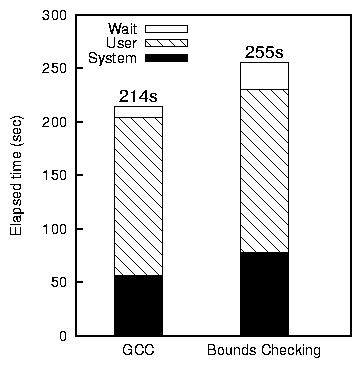
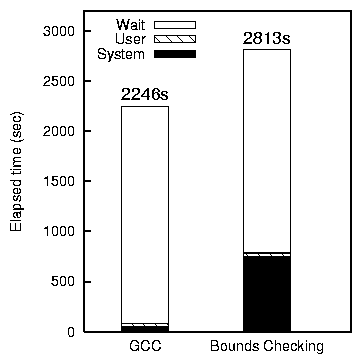 Figure 5.1: Bounds checking overhead for ReiserFS with Am-utils
(left) and Postmark (right).
The second benchmark we ran was Postmark [77],
which simulates the operation of electronic mail servers. It performs
a series of file system operations such as appends, file reads,
creations, and deletions. This benchmark uses little CPU, but is I/O
intensive. We configured Postmark to create 20,000 files, between
512-10K bytes, and perform 200,000 transactions. Create and delete,
and, read and write operations were selected with equal probability.
We chose these parameters as they are typically used and recommended
for file system benchmarks [127].
Figure 5.1 compares Postmark results for ReiserFS compiled
with our port of BCC and ReiserFS compiled with plain GCC. In this
case, the system time overhead is around 14 times. However, since
there is a significant wait time spent waiting for I/O, the overall
elapsed time has only 25% overhead.
To determine the residual overhead from using instrumented code, we
measured system performance once all bounds-checking tests have been
turned off. We observed that the performance in this case
was within 3-4% of the original uninstrumented performance.
Our results indicate that we have significantly cut down on the
overhead from bounds checking. Moreover, once bounds checking is
turned off, performance is close to the unchecked case.
Figure 5.1: Bounds checking overhead for ReiserFS with Am-utils
(left) and Postmark (right).
The second benchmark we ran was Postmark [77],
which simulates the operation of electronic mail servers. It performs
a series of file system operations such as appends, file reads,
creations, and deletions. This benchmark uses little CPU, but is I/O
intensive. We configured Postmark to create 20,000 files, between
512-10K bytes, and perform 200,000 transactions. Create and delete,
and, read and write operations were selected with equal probability.
We chose these parameters as they are typically used and recommended
for file system benchmarks [127].
Figure 5.1 compares Postmark results for ReiserFS compiled
with our port of BCC and ReiserFS compiled with plain GCC. In this
case, the system time overhead is around 14 times. However, since
there is a significant wait time spent waiting for I/O, the overall
elapsed time has only 25% overhead.
To determine the residual overhead from using instrumented code, we
measured system performance once all bounds-checking tests have been
turned off. We observed that the performance in this case
was within 3-4% of the original uninstrumented performance.
Our results indicate that we have significantly cut down on the
overhead from bounds checking. Moreover, once bounds checking is
turned off, performance is close to the unchecked case.
Chapter 6
Static Analysis as a Means for Facilitating Runtime Checking
In this section we discuss possible uses of static analysis to
facilitate runtime checking. In particular, we focus on two
categories of uses: static analysis for helping with runtime bounds
checking (Section 6.1), and the general case of using
static analysis for helping with code instrumentation (Section
6.2).
6.1 Static Analysis for Bounds Checking
Static analysis has been used for improving bounds checking system in
several ways.
The general problem of bounds checking can be divided into two
subproblems: (1) identifying a given memory reference's referent
object and thus its bounds (bound lookup problem), and (2)
comparing the reference's address with the referent's bounds and
raising an exception if the bound is violated (bound
comparison problem). One of the common uses of static analysis has
been used in solving the bound comparison subproblem. The general
approach is to eliminate unnecessary checks, so that the number of
checks is reduced. However, as seen in Section 5.4.1, these
techniques may not be valid in the presence of concurrency.
Gupta [64] used flow analysis techniques to
avoid redundant bound checks. Although this technique guarantees
to identify any array bound violation, it does not necessarily detect
them at the time of the error. This was done to reduce the
overhead associated with bounds checking within a loop. Such
bound-checks are moved outside the loop so that checking them
guarantees prevention of bound overflow errors within the loop body.
ABCD [22] is a light-weight algorithm for eliminating
Array Bounds Checks on Demand.
Despite its simplicity, ABCD has proved to be quite effective. BOON
[40] checks memory errors in using standard string
library functions. It formulates memory buffer overruns as integer
range analysis problem. Its approach consists of two logical steps:
(1) infer possible ranges for array indices, and (2) for each possible
input, check using range analysis if any memory access falls beyond an
array's limits. Larson and Austin present an interesting extension to
this idea. Their method is identical to BOON's approach in step (1).
However, for detecting possible inputs in step (2), they argue against
using static analysis. In general, any static analysis cannot always
determine exactly which paths will be taken at runtime. Hence, BOON's
method (which relies on symbolic execution) may produce false
positives. Larson and Austin's approach is to dynamically monitor
variable values at runtime possibly inferring all possible ranges in
which they can fall. Using this information in the range analysis,
one can potentially perform well-informed bounds checks.
CCured [95] is the project most similar to our work in spirit.
CCured uses a combination of static analysis and runtime checking to
detect all memory errors in C programs.
CCured is a source-to-source converter that accepts as
input a C program, and outputs another C program instrumented with
bounds-checks. It uses type-based static analysis to eliminate
redundant memory checks statically. The idea is to assign type
qualifiers (through user annotations) to individual pointers.
Thereafter, the static analysis infers type qualifiers
throughout the program using this initial set of qualifiers. If the
inferred type of a pointer is safe, it is not bounds-checked at
runtime; for all other memory accesses, runtime checks are inserted.
In CCured, pointers and the memory objects they point to can be
typed or untyped. A typed pointer is either
SAFE, or SEQ (sequential), and points only to typed
memory. Memory typing information is dynamically maintained in a
bitmap at runtime. For operations on SAFE pointers, CCured does
not insert any bounds checking code; safety is ensured by disallowing
any arithmetic on a SAFE pointer, and checking the pointer for
only NULL value at runtime. Pointer arithmetic is allowed on
SEQ pointers: in fact, SEQ pointers were introduced for
memory traversal operations (e.g., array references). In contrast, an
untyped pointer always points to an untyped memory region. All
operations on an untyped pointer are checked for bound overflows every
time it is dereferenced.
With this type system in place, CCured's working can be understood as
a sequence of three steps: (1) disallow incompatible operations, like
pointer arithmetic on SAFE types, (2) statically validate using
type inference which operations need not be checked, and (3) for all
other operations, insert runtime checks. CCured enforces the
invariant that untyped pointers cannot access typed memory areas.
Consider the following example:
01    struct elem {
02        int * UNTYPED unsafe_pointer;
03        int * SAFE	safe_pointer;
04    };
05    int func (struct elem * SEQ p) {
06        struct elem * SAFE e = NULL;
07        int s = 0;
08        for (int i = 0; i < 100; i++) {
09            e = (struct elem * SAFE) (p+i);	//out-of-bounds check
10            s += *(e->unsafe_pointer;	//No out-of-bounds check on e,
					//out-of-bounds check on e->unsafe_pointer
11            s += *(e->safe_pointer;		//No out-of-bounds check on e,
				//Only NULL check on e->safe_pointer
12        }
13        return s;
14    }
This example demonstrates the use of typed pointers and untyped
pointers. In this case the programmer has annotated the code with
SAFE and UNTYPED annotations. However, in this case
CCured could have inferred these attributes. Line 09 casts a
SEQ pointer p to SAFE pointer e. A
bounds-check is performed at this step. However, e is not
checked for bounds overflow after this step.
A most conservative translation is to consider all pointers untyped.
Thereafter, CCured infers SAFE and SEQ pointers using a
flow-sensitive analysis. This involves constraint generation and
solving for type inference. The authors report that in general even
without programmer annotations CCured can infer many cases of
pointer-typing information. However, the programmers may use
annotations for optimizations.
CCured is sound: it detects all spatial memory errors using bounds
checks and NULL-pointer checks. For temporal errors it provides
its own garbage collection mechanism. Note that a language-based
garbage collector makes it a poor candidate for use in systems
programming, since the performance characteristic of the code is not
obvious from the source code itself-there is an unpredictable and
varying garbage collection overhead.
6.1.2 Static Analysis in BCC
BCC employs various static analyses during the course of compilation.
Consider the issue of padding variables for the purpose of detecting
bound overflows. Jones and Kelly's implementation [75]
does not pad stack variables if both of the following conditions hold
for them: (1) the variable is not a pointer, and (2) the variable's
address is not assigned to any pointer in the scope of the function.
Note that BCC derives this information from GCC's analysis framework.
By not padding these variables, BCC reduces stack usage of the checked
program.
As seen in Section 5.4.1, KBCC leverages GCC's optimization
framework to remove unnecessary checks from the program. This is an
example of conservative flow-sensitive analysis for mitigating the
bound conversion problem.
6.2 Static Analysis for Instrumentation of Code
Static analysis of code can also be useful in the more general case of
instrumenting code for tracing support, checking, etc. In this
section we first discuss aspect oriented programming, a
generic approach to instrumenting arbitrary code. We then present the
compile-time instrumentation framework of Aristotle, a
runtime verification system we developed.
6.2.1 Aspect-Oriented Programming
Aspect-oriented programming (AOP) is an upcoming programming paradigm
which allows crosscutting concerns to be modularized as aspects that
are separated from objects. Aspects can specify synchronization
policies, resource sharing and performance optimizations over objects.
A compiler called weaver, weaves aspects and objects together
into a program.
The AOP paradigm was inspired by the difficulty programmers often face
in understanding how the code works because it is often poorly
localized, and its relation to the execution flow of the main code is
hard to follow. Often, implementation for aspects of the program,
like the scheduling policy is spread throughout the entire source
code. As a result, understanding the code and maintaining it becomes
difficult. Often, changing only a particular aspect of the code
requires changing the source code in many different places.
Aspect-oriented approaches attempt to address these problems by
modularizing the scattered pieces of source code that implement a
single concept.
Aspects are described as specifications in a spec language.
The language comprises of a series of pattern-action
pairs. The weaver searches for each occurrence of the pattern in the
source code, and performs the corresponding action on it. For
example, the action could be to insert a function call, or signal an
error. AspectJ is an aspect-oriented framework for Java. It
was an offshoot of the MOPS project (Section 3.3.4) for
separating higher level protocol specifications from source code. The
system comprises of an aspect-oriented language (AspectJ) for Java and
a weaver. Some other frameworks currently under development are
AspectC++ [1] and AspectC [33].
All these approaches use simple pattern matching when searching for
the pattern in the target code (C or Java). The only form of
flow-sensitive pattern searching supported is using the cflow
keyword. However, the weaver as such does not perform any
flow-sensitive analysis. Any flow-sensitive conditions in the pattern
code are evaluated at runtime. This can significantly slow
down runtime performance for frequently executed code.
The Bossa system [4] is an example of an AOP system that
allows the programmer to use flow-sensitive static analysis for
specifying patterns. The Bossa spec language supports temporal logic
based flow-sensitive pattern specifications. Bossa has been used with
the Linux kernel for separating the scheduling framework from the
mainstream kernel.
Several other tools exist for code instrumentation. CTool
[5] is a simple source transformation tool. AST-log
[105] is a tool for simple pattern matching in parse trees.
Tools such as ATOM [119] provide support for binary level
translation. Purify [106] performs binary level translation
of generic programs for inserting bound checking.
6.2.2 Source Code Instrumentation in Aristotle
Aristotle is a runtime verification system for the Linux kernel
currently under development in our research group. Aristotle
continually monitors kernel execution at runtime, checking it for
conformance to pre-defined properties. Kernel monitoring is
facilitated by tracing events generated by an instrumented kernel.
The tracing events are typically function calls made to Aristotle's
runtime checking engine as shown in Figure 6.1. For the
purpose of our discussion, we will focus on KGCC.
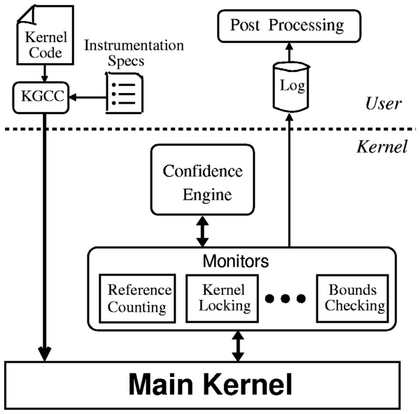 Figure 6.1:
Architectural overview of the Aristotle system. KGCC instruments
kernel code with monitoring calls. During the execution of the
instrumented kernel, the monitoring calls invoke individual monitors
to dynamically verify system properties.
KGCC is a special compiler used by Aristotle for instrumenting the
Linux kernel for runtime monitoring. KGCC is an extension to GCC. In
fact, the KBCC compiler introduced in Section 5.4.1 is a
subset of KGCC. KGCC is a general source code instrumentation
framework based on GCC.
Aristotle inserts custom monitoring code into the Linux kernel using
KGCC. KGCC scans the parse tree generated during compilation and
instruments it with the monitoring code. Using a compiler for
statically instrumenting kernel code offers several advantages.
Compile-time instrumentation can benefit from higher-level semantic
information about the code, e.g. user-defined data types that are
typically not available to binary rewriters. Moreover, static
analysis can be used to guide the placement of the monitoring code.
In this context, Aristotle uses the compiler both as a provider of
parse trees, type information, etc., and as a useful tool for
instrumenting programs at the parse-tree level, code optimization,
etc. KGCC also allows us to separate the monitoring code from the
source code, making monitoring code easily portable to different
kernel versions in the spirit of aspect-oriented programming.
GCC is a heavy-weight C compiler with little documentation of its
internals. Static checking and meta-compilation
[66] projects in the past have preferred
light-weight compilers with well-documented internals over GCC
[27], since they are much easier to understand and modify.
The Linux kernel, however, is designed to compile exclusively with
GCC, forcing Aristotle to execute code compiled with KGCC rather than
just use the compiler for its parsing capabilities. These
considerations obviate our choice of a GCC-based approach. KGCC was
originally based on GCC-3.2 and later ported to GCC-4.0 (beta).
GCC-4.0 offers several advantages: a cleaner interface to
manipulate parse trees, better documentation which significantly
reduced development times, and advanced optimizations.
Like AOP, KGCC's instrumentations are also guided by
pattern-action pairs. Patterns identify source code constructs of
interest, and actions identify the corresponding actions to be
performed on the source code. For each such pair, GCC scans the parse
tree for every occurrence of pattern, and inserts the
corresponding action in the appropriate parse-tree node.
Patterns can be specified using any information typically available in
the parse tree: types, identifiers, containing functions, file names,
etc. Note that in our current implementation, we do not yet support a
generic language for specifying patterns and actions. KGCC currently
hard-codes these into the compiler itself. However, our design is
easily amenable to an AOP "weaver" like setup.
KGCC actions can be logically divided into two categories:
pre-checks and post-ops. Pre-checks are to be performed before
executing the operation identified in the pattern. For example, in
the case of memory-bounds checking (see Section 5.4.1), a
pre-check would verify pointer sanity before each pointer dereference.
A post-op is inserted after the specified operation and can be an
arbitrary piece of C code (as is the case for bounds checking) or
simply a call to the event dispatcher. In the latter case, the
operation (event) will be dispatched to the confidence engine and
may be logged for post-processing purposes. For example, when
reference-counting monitoring is enabled, an operation that
manipulates an object's reference count would be dispatched to the
reference-counting monitor to check that the operation does not
violate a system-correctness property.
Figure 6.1:
Architectural overview of the Aristotle system. KGCC instruments
kernel code with monitoring calls. During the execution of the
instrumented kernel, the monitoring calls invoke individual monitors
to dynamically verify system properties.
KGCC is a special compiler used by Aristotle for instrumenting the
Linux kernel for runtime monitoring. KGCC is an extension to GCC. In
fact, the KBCC compiler introduced in Section 5.4.1 is a
subset of KGCC. KGCC is a general source code instrumentation
framework based on GCC.
Aristotle inserts custom monitoring code into the Linux kernel using
KGCC. KGCC scans the parse tree generated during compilation and
instruments it with the monitoring code. Using a compiler for
statically instrumenting kernel code offers several advantages.
Compile-time instrumentation can benefit from higher-level semantic
information about the code, e.g. user-defined data types that are
typically not available to binary rewriters. Moreover, static
analysis can be used to guide the placement of the monitoring code.
In this context, Aristotle uses the compiler both as a provider of
parse trees, type information, etc., and as a useful tool for
instrumenting programs at the parse-tree level, code optimization,
etc. KGCC also allows us to separate the monitoring code from the
source code, making monitoring code easily portable to different
kernel versions in the spirit of aspect-oriented programming.
GCC is a heavy-weight C compiler with little documentation of its
internals. Static checking and meta-compilation
[66] projects in the past have preferred
light-weight compilers with well-documented internals over GCC
[27], since they are much easier to understand and modify.
The Linux kernel, however, is designed to compile exclusively with
GCC, forcing Aristotle to execute code compiled with KGCC rather than
just use the compiler for its parsing capabilities. These
considerations obviate our choice of a GCC-based approach. KGCC was
originally based on GCC-3.2 and later ported to GCC-4.0 (beta).
GCC-4.0 offers several advantages: a cleaner interface to
manipulate parse trees, better documentation which significantly
reduced development times, and advanced optimizations.
Like AOP, KGCC's instrumentations are also guided by
pattern-action pairs. Patterns identify source code constructs of
interest, and actions identify the corresponding actions to be
performed on the source code. For each such pair, GCC scans the parse
tree for every occurrence of pattern, and inserts the
corresponding action in the appropriate parse-tree node.
Patterns can be specified using any information typically available in
the parse tree: types, identifiers, containing functions, file names,
etc. Note that in our current implementation, we do not yet support a
generic language for specifying patterns and actions. KGCC currently
hard-codes these into the compiler itself. However, our design is
easily amenable to an AOP "weaver" like setup.
KGCC actions can be logically divided into two categories:
pre-checks and post-ops. Pre-checks are to be performed before
executing the operation identified in the pattern. For example, in
the case of memory-bounds checking (see Section 5.4.1), a
pre-check would verify pointer sanity before each pointer dereference.
A post-op is inserted after the specified operation and can be an
arbitrary piece of C code (as is the case for bounds checking) or
simply a call to the event dispatcher. In the latter case, the
operation (event) will be dispatched to the confidence engine and
may be logged for post-processing purposes. For example, when
reference-counting monitoring is enabled, an operation that
manipulates an object's reference count would be dispatched to the
reference-counting monitor to check that the operation does not
violate a system-correctness property.
Chapter 7
Conclusions and Future Work
The contributions of this work are that we have presented a survey of
available techniques for static checking of software. We have
performed a comprehensive survey of existing runtime bounds checking
techniques.
The main conclusion of this paper is that, where correctness
guarantees are desired, static analysis should be combined with
runtime checking.
We have seen that static checking of C programs is limited in its
scope due to computational limits. Although static checkers have been
designed for detecting bugs in software, these checkers are often
unsound and can miss bugs. Attempts to achieve complete soundness
result in loss of precision in the form of a large number of false
alarms. These false alarms are a significant practical drawback.
Existing static checking systems have favored one of soundness and
precision in their design trade-offs. Soundness, as incorporated in
systems like Cqual, requires user participation in the form of program
annotations to be useful. Hence, although they may be adopted in
fresh projects, it is unlikely that they will be adopted in existing
systems.
Other systems favor bug finding power and precision over soundness,
and can be best described as best-effort checkers. Even though they
are unsound, they are nevertheless useful. Completely sound and
precise systems are not compatible with existing C code. Since
software checking for legacy C code like the Linux kernel cannot give
correctness guarantees, best-effort bug detection is a useful
practical alternative for increasing software quality.
It is evident that static checking alone is not in the state to give
correctness guarantees about large complex software like the Linux
kernel. Faced with this impossibility, the alternative has been to
use runtime techniques for providing correctness guarantees. However,
runtime checking techniques themselves are not acceptable in
production systems due to performance reasons.
The central thesis of this paper is that, where correctness guarantees
are desired, static analysis should be combined with runtime checking.
The rest of this chapter is organized as follows. Section
7.1 discusses our conclusions about static checking
techniques. Section 7.2 discusses our conclusions about
runtime bounds checking. We present possible future directions of
research in Section 7.3.
7.1 Static Checking
The cost of repairing a bug increases along the software development
time-line. An early discovery can result in substantial savings,
making static checking a useful tool for software developers.
From our survey of annotation-based checkers and tool-based checkers,
we believe that both have some unique benefits. Annotation-based
systems can be more sound and precise, but require additional effort
on the part of the programmer. Tool-based checkers are easier to use,
especially if they are extensible, but they are often unsound and need
innovative design to be powerful in catching bugs.
Annotations can be viewed as a mechanism by which programmers
help a static checker to check their code. Static checking
systems use annotations for some or all of the following purposes:
- Assumptions and Invariants: Programmers use annotations
to specify assumptions and invariants. Thus the static analyzer is
freed from the responsibility of inferring invariants. Completely
sound and precise static invariant inference is often intractable.
Thus with programmer help, the static analyzer can still usefully
check program properties without being any more unsound and imprecise.
- Interface Specifications: Programmers use annotations
to specify procedure interfaces. This often saves the static analyzer
from (a possibly unsound and imprecise) inter-procedural analysis.
More importantly, this leads to highly scalable static analyzers since
procedures can be easily checked in isolation. Interface level
annotations are arguably a useful means to automatically generate code
documentation as well.
- Extensibility: Some static analyzers like ESC/Java (see
Section 3.1.4) give programmers much freedom in specifying
annotations (ESC/Java allows programmers to specify arbitrary first
order logic annotations). Hence programmers can extend the
default checking done by the checker with their own custom checks.
Tool-based checkers are trying to solve a much harder problem:
checking possibly arbitrary code where the code speaks for
itself (no annotations). In fact, tool-based checkers represent a
much advanced point in the automated checking design space, especially
with regard to engineering novelty. Since this problem is hard, tool
based checkers trade-off soundness for tractability. From our survey
we infer the following key features that increase the power and
usefulness of tool-based checkers:
- Extensibility: Most of the bugs in software are due to
violations of some system-specific properties. For a checker to be
useful in general, it should be able to detect such bugs. Tool-based
checkers like ESP and Metacompilation allow the programmer to specify
system-specific properties separately from code. The checker then
uniformly checks the entire code base with this property
specification. Thus, both tool-based and annotation-based methods use
the programmer-only that tool-based methods can use them even with
unmodified code.
- Statistical Inference: Best-effort checkers can be more
bold in their bug detection strategies than their sound and
complete counterparts. One example of this ideology is the use of
statistical inference for deriving system invariants, and then
checking the code for violations of these invariants. Note that such
an analysis can be very imprecise, and heuristics are needed to
properly sort and rank such errors.
- Rank Bugs: To win programmers' confidence, the checker
must be useful. Just finding bugs is not enough. There should
be minimum false alarms. Again, this is a difficult problem
especially if the checker is aggressive in finding as many bugs as
possible. One solution is to rank bugs: bugs are ranked in the order
of decreasing likelihood of being a genuine bug and not just a false
alarm.
7.2 Runtime Bounds Checking
Memory access errors cannot always be
verified statically. However, they also represent a serious problem in
systems today. Runtime bounds checking, possibly with help from
static analysis, is a viable approach to ensuring memory safety at
runtime.
Runtime memory access checking schemes can be evaluated based on four
criteria [132]:
- The ability to detect all memory errors,
- low performance overhead,
- the ability to handle all C programs without modification, and
- preserving the existing C memory-allocation model.
We have seen classification of bounds checking methods based on their
approach for handling the bounds lookup subproblem. We proposed a
formal classification for existing techniques based on capability
checking and availability checking. Capability checking are much
better than availability-based techniques in most respects except one.
Capability-based techniques are sound in that they can potentially
detect all memory errors, they are much faster, they can protect existing C
memory allocation model, and they can be backward-compatible with most
existing C source code. However, capability-based methods are often
incompatible with existing pre-compiled C code (e.g., libraries).
The independent subproblem of bounds comparison has also received much
attention. Static analysis has been successfully used for eliminating
unnecessary checks on bound accesses. A radically different approach
is the use of hardware-based techniques.
The Linux kernel bounds checking compiler is an instructive experiment
in runtime bounds checking of large safety-critical software. In
particular, we have successfully applied a known bounds checking
technique to check the Linux kernel. Arguably, this is the only
existing software approach that could be applied to bounds checking of
the Linux kernel in a completely backward-compatible way. During the
process of this port, we identified and solved several issues like
invalid pointers, redundant checks, etc.
7.3 Future Work
We plan to pursue future work in two directions: (1) bounds checking,
and (2) static analysis for runtime checking.
Bounds Checking
Performance overhead is the bane of runtime bounds checking. Whereas
removal of redundant pointer checks did improve KBCC's performance, it
is still too slow for deployment in production environments. Hardware
based techniques, though promising, fall short in comprehensiveness
and speed in some cases. We are exploring an alternative novel approach to
address this problem. The idea is that after bounds checks have been
exercised a certain number of times, they can be turned off, giving
back the original performance.
Static Analysis for Runtime Checking
We are actively developing the Aristotle system introduced in
Section 6.2.2. Aristotle will be used for verifying
properties of the Linux kernel at runtime. We plan to leverage static
analysis in two ways to help achieve this goal:
- Minimize performance overhead due to monitoring: statically
deduce and verify all that is possible, leaving only the rest for
runtime checking and verification.
- Provide fine-grained control to Aristotle developers for
arbitrarily instrumenting kernel code at compile time.
In the context of bounds checking, we have achieved limited success in
fulfilling the first requirement. For providing fine-grained
instrumentation control, we plan to develop upon ideas from
aspect-oriented programming research to implement a useful extension
to GCC for arbitrarily instrumenting source code at compile time. In
particular, our GCC support is nearly ready, and we are working on an
advanced specification language for describing the "aspects."
Recent deliberations have suggested the possibility that overloading
the already heavy-weight GCC compiler with this facility may not be a
good idea, and the analysis engine and instrumentation engine should
be implemented as separate tools.
Bibliography
- [1]
-
AspectC++ Homepage.
www.aspectc.org.
- [2]
-
Splint Guide.
www.splint.org/guide/guide.html.
- [3]
-
Splint Manual.
www.splint.org/manual/manual.html.
- [4]
-
The Bossa Project.
www.emn.fr/x-info/bossa/.
- [5]
-
The GNU CTool Project.
http://ctool.sourceforge.net.
- [6]
-
A. Bensoussan and C. T. Clingen and R. C. Daley.
The Multics Virtual Memory: Concepts and Design.
Communcations of the ACM, 15(5):308-318, 1972.
- [7]
-
A. Blass and Y. Gurevich.
Inadequacy of Computable Loop Invariants.
ACM Transactions on Computational Logic, 2(1):1-11, 2001.
- [8]
-
S. Abramsky and C. Hankin, editors.
Abstract interpretation of declarative languages.
Halsted Press, New York, NY, USA, 1987.
- [9]
-
M. Accetta, R. Baron, W. Bolosky, D. Golub, R. Rashid, A. Tevanian, and
M. Young.
Mach: A new kernel foundation for UNIX development.
In Proceedings of the Summer USENIX Technical Conference, pages
93-112, Summer 1986.
- [10]
-
A. Aiken, J. S. Foster, J. Kodumal, and T. Terauchi.
Checking and inferring local non-aliasing.
SIGPLAN Not., 38(5):129-140, 2003.
- [11]
-
W. Arbaugh, D. Farber, and J. Smith.
A Secure and Reliable Bootstrap Architecture.
In Proceedings of the IEEE Symposium on Security and Privacy,
Oakland, CA, May 1997.
- [12]
-
W. A. Arbaugh, W. L. Fithen, and J. McHugh.
Windows of Vulnerability: A Case Study Analysis.
IEEE Computer, 33(12):52-59, December 2000.
- [13]
-
T. M. Austin, S. E. Breach, and G. S. Sohi.
Efficient detection of all pointer and array access errors.
SIGPLAN Not., 29(6):290-301, 1994.
- [14]
-
T. Ball, R. Majumdar, T. Millstein, and S. K. Rajamani.
Automatic predicate abstraction of c programs.
In Proc. ACM SIGPLAN Conference on Programming Language Design
and Implementation (PLDI). ACM Press, 2001.
Appeared in ACM SIGPLAN Notices 36(5), pp. 203-213.
- [15]
-
T. Ball, A. Podelski, and S. K. Rajamani.
Relative completeness of abstraction refinement for software model
checking.
In Joost-Pieter Kaoen and Perdita Stevens, editors, Proceedings
of TACAS02: Tools and Algorithms for the Construction and Analysis of
Systems, volume 2280 of LNCS, pages 158-172, Grenoble, France, April
2002. Springer-Verlag.
- [16]
-
T. Ball and S. K. Rajamani.
The SLAM toolkit.
In CAV '01: Proceedings of the 13th International Conference on
Computer Aided Verification, pages 260-264. Springer-Verlag, 2001.
- [17]
-
T. Ball and S. K. Rajamani.
The slam project: Debugging system software via static analysis.
In Conference Record of the 29th Annual ACM Symposium on
Principles of Programming Languages, pages 1-3. ACM Press, 2002.
- [18]
-
R. Balzer.
Mediating connectors.
Technical report, USC/ISI, 1998.
www.isi.edu/software-sciences/instrumented-connectors.html.
- [19]
-
R. Balzer and N. Goldman.
Mediating connectors.
In Proceedings of the 19th IEEE International Conference on
Distributed Computing Systems Workshop, pages 72-7, Austin, TX, June 1999.
- [20]
-
B. Bershad, S. Savage, P. Pardyak, E. G. Sirer, D. Becker, M. Fiuczynski,
C. Chambers, and S. Eggers.
Extensibility, safety, and performance in the SPIN operating
system.
In Proceedings of the 15th ACM Symposium on Operating System
Principles (SOSP '95), pages 267-284, Copper Mountain Resort, CO, December
1995. ACM SIGOPS.
- [21]
-
W. R. Bevier.
Kit: A Study in Operating System Verification.
IEEE Transactions on Software Engineering, 15(11):1382-1396,
1989.
- [22]
-
R. Bodik, R. Gupta, and V. Sarkar.
Abcd: Eliminating array bounds checks on demand.
In PLDI '00: Proceedings of the ACM SIGPLAN 2000 conference on
Programming language design and implementation, pages 321-333, New York,
NY, USA, 2000. ACM Press.
- [23]
-
C. Boyapati and M. C. Rinard.
A parameterized type system for race-free Java programs.
volume 36(11) of SIGPLAN Notices, pages 56-69, November 2001.
- [24]
-
T. Bray.
The Bonnie home page.
www.textuality.com/bonnie, 1996.
- [25]
-
H. T. Brugge.
The BCC home page.
http://web.inter.NL.net/hcc/Haj.Ten.Brugge, 2001.
- [26]
-
W. R. Bush, J. D. Pincus, and D. J. Sielaff.
A static analyzer for finding dynamic programming errors.
Softw. Pract. Exper., 30(7):775-802, 2000.
- [27]
-
C. W. Fraser and D. R. Hanson.
A Retargetable C Compiler: Design and Implementation.
Addison-Wesley Longman Publishing Co., Inc., 1995.
- [28]
-
S. Chiba.
A metaobject protocol for c++.
In OOPSLA '95: Proceedings of the tenth annual conference on
Object-oriented programming systems, languages, and applications, pages
285-299, New York, NY, USA, 1995. ACM Press.
- [29]
-
T. Chiueh, G. Venkitachalam, and P. Pradhan.
Integrating segmentation and paging protection for safe, efficient
and transparent software extensions.
In Proceedings of 17th ACM Symposium on Operating Systems
Principles (SOSP '99), pages 140-153, Kiawah Island Resort, near
Charleston, SC, December 1999. ACM SIGOPS.
- [30]
-
J. Choi, K. Lee, A. Loginov, R. O'Callahan, V. Sarkar, and M. Sridharan.
Efficient and precise datarace detection for multithreaded
object-oriented programs.
pages 258-269, 2002.
- [31]
-
A. Chou, B. Chelf, D. R. Engler, and M. Heinrich.
Using meta-level compilation to check FLASH protocol code.
In Architectural Support for Programming Languages and Operating
Systems, pages 59-70, 2000.
- [32]
-
A. Chou, J. Yang, B. Chelf, S. Hallem, and D. Engler.
An Empirical Study of Operating Systems Errors.
In Proceedings of the 18th ACM Symposium on Operating System
Principles (SOSP 2001), Chateau Lake Louise, Banff, Canada, October 2001.
ACM SIGOPS.
- [33]
-
Y. Coady, G. Kiczales, M. Feeley, and G. Smolyn.
Using AspectC to Improve the Modularity of Path-Specific
Customization in Operating System Code.
In Joint 8th European Software Engineering Conference (ESEC) and
9th ACM SIGSOFT Symposium on the Foundations of Software Engineering (FSE),
pages 88-98, 2001.
- [34]
-
A. Coen-Porisini, G. Denaro, C. Ghezzi, and M. Pezze.
Using symbolic execution for verifying safety-critical systems.
In ESEC/FSE-9: Proceedings of the 8th European Software
Engineering Conference held jointly with 9th ACM SIGSOFT International
Symposium on Foundations of Software Engineering, pages 142-151, New York,
NY, USA, 2001. ACM Press.
- [35]
-
R. Coker.
The Bonnie++ home page.
www.coker.com.au/bonnie++, 2001.
- [36]
-
J.C. Corbett, M.B. Dwyer, J. Hatcliff, S. Laubach, C.S. Pasareanu, Robby, and
H. Zheng.
Bandera: Extracting finite-state models from java source code.
In Proceedings of 22nd International Conference on Software
Engineering, pages 439-448, 2000.
- [37]
-
P. Cousot and R. Cousot.
Comparing the galois connection and widening/narrowing approaches to
abstract interpretation.
In PLILP '92: Proceedings of the 4th International Symposium on
Programming Language Implementation and Logic Programming, pages 269-295,
London, UK, 1992. Springer-Verlag.
- [38]
-
D. Detlefs and G. Nelson and J. Saxe.
Simplify: A theorem prover for program checking.
Technical Report HPL-2003-148, HP Labs, Palo Alto, CA, 2003.
- [39]
-
D. Evans and D. Larochelle.
Improving Security Using Extensible Lightweight Static Analysis.
IEEE Software, 19(1):42-51, 2002.
- [40]
-
D. Wagner and J. S. Foster and E. A. Brewer and A. Aiken.
A First Step Towards Automated Detection of Buffer Overrun
Vulnerabilities.
In Networking and Distributed System Security Symposium 2000,
San Diego, CA, February 2000.
- [41]
-
Department of Defense.
Trusted computer system evaluation criteria (The Orange Book).
Technical Report DoD 5200.28-STD, National Computer Security
Center, Alexandria, VA, December 1985.
www.dynamoo.com/orange.
- [42]
-
D. L. Detlefs.
An overview of the extended static checking (esc) system.
In Proceedings of the First Workshop on Formal Methods in
Software Practice, pages 1-9, January 1996.
- [43]
-
D. L. Detlefs, R. M. Leino, G. Nelson, and J. B. Saxe.
Extended Static Checking.
Technical Report SRC-159, Compaq SRC, 130 Lytton Ave., Palo Alto,
December 1998.
- [44]
-
N. Dor, M. Rodeh, and M. Sagiv.
Cssv: Towards a realistic tool for statically detecting all buffer
overflows in c.
SIGPLAN Not., 38(5):155-167, 2003.
- [45]
-
P. J. Downey, R. Sethi, and R. E. Tarjan.
Variations on the common subexpression problem.
J. ACM, 27(4):758-771, 1980.
- [46]
-
D. Engler and K. Ashcraft.
RacerX: effective, static detection of race conditions and
deadlocks.
In Proceedings of the 19th ACM Symposium on Operating Systems
Principles, pages 237-252. ACM Press, 2003.
- [47]
-
D. Engler, B. Chelf, A. Chou, and S. Hallem.
Checking System Rules Using System-Specific
Programmer-Written Compiler Extensions.
In Proceedings of the Fourth Symposium on Operating Systems
Design and Implementation (OSDI 2000), pages 1-16, San Diego, CA, October
2000.
- [48]
-
D. Engler, D. Y. Chen, S. Hallem, A. Chou, and B. Chelf.
Bugs as Deviant Behavior: A General Approach to Inferring
Errors in Systems Code.
In Proceedings of the 18th ACM Symposium on Operating System
Principles (SOSP 2001), Chateau Lake Louise, Banff, Canada, October 2001.
ACM SIGOPS.
- [49]
-
D. Evans, J. Guttag, J. Horning, and Y. M. Tan.
LCLint: A Tool for Using Specifications to Check Code.
In Proceedings of the ACM SIGSOFT '94 Symposium on the
Foundations of Software Engineering, pages 87-96, 1994.
- [50]
-
M. Fahndrich and R. DeLine.
Adoption and focus: practical linear types for imperative
programming.
In PLDI '02: Proceedings of the ACM SIGPLAN 2002 Conference on
Programming language design and implementation, pages 13-24, New York, NY,
USA, 2002. ACM Press.
- [51]
-
C. Flanagan and S. N. Freund.
Type-based race detection for Java.
pages 219-232, 2000.
- [52]
-
C. Flanagan and S. N. Freund.
Atomizer: A dynamic atomicity checker for multithreaded programs.
In Proc. 31st ACM SIGPLAN Symposium on Principles of
Programming LANGUAGES (POPL), January 2004.
- [53]
-
C. Flanagan and K. Rustan M. Leino.
Houdini, an annotation assistant for esc/java.
In FME '01: Proceedings of the International Symposium of Formal
Methods Europe on Formal Methods for Increasing Software Productivity, pages
500-517, London, UK, 2001. Springer-Verlag.
- [54]
-
C. Flanagan, K. Rustan M. Leino, M. Lillibridge, G. Nelson, J. B. Saxe, and
R. Stata.
Extended static checking for java.
In PLDI, pages 234-245, 2002.
- [55]
-
C. Flanagan and S. Qadeer.
Predicate abstraction for software verification.
In POPL '02: Proceedings of the 29th ACM SIGPLAN-SIGACT
symposium on Principles of programming languages, pages 191-202, New York,
NY, USA, 2002. ACM Press.
- [56]
-
C. Flanagan and S. Qadeer.
A type and effect system for atomicity.
In Proc. ACM SIGPLAN Conference on Programming Language Design
and IMPLEMENTATION (PLDI), pages 338-349. ACM Press, 2003.
- [57]
-
J. S. Foster, T. Terauchi, and A. Aiken.
Flow-sensitive type qualifiers.
In PLDI '02: Proceedings of the ACM SIGPLAN 2002 Conference on
Programming Language Design and Implementation, pages 1-12, New York, NY,
USA, 2002. ACM Press.
- [58]
-
G. Kiczales and J. D. Rivieres.
The Art of the Metaobject Protocol.
MIT Press, Cambridge, MA, USA, 1991.
- [59]
-
E. Gabber, C. Small, J. Bruno, J. Brustoloni, and A. Silberschatz.
The Pebble component-based operating system.
In Proceedings of the Annual USENIX Technical Conference, pages
267-282, Monterey, CA, June 1999.
- [60]
-
V. Ganapathy, S. Jha, D. Chandler, D. Melski, and D. Vitek.
Buffer overrun detection using linear programming and static
analysis.
In CCS '03: Proceedings of the 10th ACM Conference on Computer
and Communications Security, pages 345-354, New York, NY, USA, 2003. ACM
Press.
- [61]
-
P. Godefroid.
Model checking for programming languages using verisoft.
In Proceedings of the 24th ACM Symposium on Principles of
Programming Languages, pages 174-186, 1997.
- [62]
-
D. B. Golub and R. P. Draves.
Moving the Default Memory Manager out of the Mach Kernel.
In Proceeding of the Second USENIX Mach Symposium Conference,
pages 177-88, Monterey, CA, November 1991.
- [63]
-
D. Grossman, G. Morrisett, T. Jim, M. Hicks, Y. Wang, and J. Cheney.
Region-based memory management in cyclone.
In PLDI '02: Proceedings of the ACM SIGPLAN 2002 Conference on
Programming language design and implementation, pages 282-293, New York,
NY, USA, 2002. ACM Press.
- [64]
-
R. Gupta.
Optimizing array bound checks using flow analysis.
ACM Letters on Programming Languages and Systems,
2(1-4):135-150, 1993.
- [65]
-
J. V. Guttag and J. J. Horning.
Larch: languages and tools for formal specification.
Springer-Verlag New York, Inc., New York, NY, USA, 1993.
- [66]
-
S. Hallem, B. Chelf, Y. Xie, and D. Engler.
A System and Language for Building System-Specific, Static
Analyses.
In ACM Conference on Programming Language Design and
Implementation, pages 69-82, Berlin, Germany, June 2002.
- [67]
-
M. Hicks, G. Morrisett, D. Grossman, and T. Jim.
Safe and flexible memory management in Cyclone.
Technical Report CS-TR-4514, University of Maryland Department of
Computer Science, July 2003.
Also published as University of Maryland Institute for Advanced
Computer Studies (UMIACS) Technical report UMIACS-TR-2003-82.
- [68]
-
M. Hohmuth.
The Fiasco kernel: Requirements definition.
Technical Report TUD-FI98-12, TU Dresden, December 1998.
http://os.inf.tu-dresden.de/fiasco/doc.html.
- [69]
-
IEEE/ANSI.
Information Technology-Test Methods for Measuring Conformance to
POSIX-Part 1: System Interfaces.
Technical Report STD-2003.1, ISO/IEC, 1992.
- [70]
-
IEEE/ANSI.
Information Technology-Portable Operating System Interface
(POSIX)-Part 1: System Application: Program Interface (API) [C Language].
Technical Report STD-1003.1, ISO/IEC, 1996.
- [71]
-
J. Ferrante and K. J. Ottenstein and J. D. Warren.
The Program Dependence Graph and its use in Optimization.
ACM Transactions on Programming Language Systems,
9(3):319-349, 1987.
- [72]
-
J. W. Nimmer and M. D. Ernst.
Static Verification of Dynamically Detected Program Invariants:
Integrating Daikon and ESC/Java.
In Proceedings of RV'01, First Workshop on Runtime
Verification, Paris, France, July 23, 2001.
- [73]
-
T. Jim, G. Morrisett, D. Grossman, M. Hicks, J. Cheney, and Y. Wang.
Cyclone: A Safe Dialect of C.
In Proceedings of the Annual USENIX Technical Conference, pages
275-288, Monterey, CA, June 2002.
- [74]
-
N. D. Jones and F. Nielson.
Abstract interpretation: a semantics-based tool for program analysis.
pages 527-636, 1995.
- [75]
-
R. Jones and P. Kelly.
Bounds Checking for C.
Technical report.
www-ala.doc.ic.ac.uk/phjk/BoundsChecking.html.
- [76]
-
K. Rustan M. Leino and G. Nelson and J. B. Saxe.
ESC/Java User's Manual.
Technical Report 2000-002, Compaq Systems Research Center,
October 2000.
- [77]
-
J. Katcher.
PostMark: A New Filesystem Benchmark.
Technical Report TR3022, Network Appliance, 1997.
www.netapp.com/tech_library/3022.html.
- [78]
-
S. Katz and Z. Manna.
Logical analysis of programs.
Commun. ACM, 19(4):188-206, 1976.
- [79]
-
A. Kolawa and A. Hicken.
Insure++: A Tool to Support Total Quality Software.
www.parasoft.com/insure/papers/tech.htm, March 2001.
- [80]
-
S. Kumar and K. Li.
Using Model Checking to Debug Device Firmware.
In Proceedings of the 5th Symposium on Operating Systems Design
and Implementation (OSDI 2002), pages 61-74, Boston, MA, December 2002.
- [81]
-
J. Kuskin, D. Ofelt, M. Heinrich, J. Heinlein, R. Simoni, K. Gharachorloo,
J. Chapin, D. Nakahira, J. Baxter, M. Horowitz, A. Gupta, M. Rosenblum, and
J. Hennessy.
The stanford flash multiprocessor.
In ISCA '98: 25 years of the international symposia on Computer
architecture (selected papers), pages 485-496, New York, NY, USA, 1998. ACM
Press.
- [82]
-
L. Lam and T. Chiueh.
Checking Array Bound Violation Using Segmentation Hardware.
In Proceedings of the 2005 International Conference on
Dependable Systems and Networks (DSN 2005), June 2005.
- [83]
-
L. Wang and S. D. Stoller.
Run-Time Analysis for Atomicity.
In Proceedings of the Third Workshop on Runtime Verification
(RV), volume 89(2) of Electronic Notes in Theoretical Computer
Science. Elsevier, July 2003.
- [84]
-
J. Lamping, G. Kiczales, L. H. Rodriguez Jr., and E. Ruf.
An architecture for an open compiler.
In Proceedings of the IMSA'92 Workshop on Reflection and
Meta-level Architectures (A. Yonezawa and B. C. Smith, eds.), pages 95-106,
1992.
- [85]
-
W. Lee, W. Fan, M. Miller, S. Stolfo, and E. Zadok.
Toward cost-sensitive modeling for intrusion detection and response.
In Workshop on Intrusion Detection and Prevention, Seventh ACM
Conference on Computer Security, Athens, Greece, November 2000.
- [86]
-
K. Rustan M. Leino, J. B. Saxe, and R. Stata.
Checking java programs via guarded commands.
In Proceedings of the Workshop on Object-Oriented Technology,
pages 110-111, London, UK, 1999. Springer-Verlag.
- [87]
-
D. Lie, A. Chou, D. Engler, and D. Dill.
A Simple Method for Extracting Models from Protocol Code.
In The 28th Annual International Symposium on Computer
Architecture (ISCA 2001), Göteborg, Sweden, June/July 2001.
- [88]
-
D. Lie, A. Chou, D. Engler, and D. L. Dill.
A simple method for extracting models for protocol code.
In ISCA '01: Proceedings of the 28th annual international
symposium on Computer architecture, pages 192-203, New York, NY, USA, 2001.
ACM Press.
- [89]
-
M. D. Ernst and J. Cockrell and W. G. Griswold and D. Notkin.
Dynamically Discovering Likely Program Invariants to Support Program
Evolution.
IEEE Transactions on Software Engineering, 27(2):99-123,
2001.
- [90]
-
L. Mauborgne.
ASTRÉE: Verification of Absence of Run-Time Error.
In René Jacquart, editor, Building the information
Society (18th IFIP World Computer Congress), pages 384-392. The
International Federation for Information Processing, Kluwer Academic
Publishers, August 2004.
- [91]
-
Microsoft Corporation.
ESP.
www.microsoft.com/windows/cse/esp.mspx.
- [92]
-
MIT LCS.
Larch Project Home.
www.sds.lcs.mit.edu/spd/larch/.
- [93]
-
M. Musuvathi, D. Y.W. Park, A. Chou, D. R. Engler, and D. L. Dill.
CMC: A Pragmatic Approach to Model Checking Real Code.
In Proceedings of the 5th Symposium on Operating Systems Design
and Implementation (OSDI 2002), pages 75-88, Boston, MA, December 2002.
- [94]
-
N. Suzuki and K. Ishihata.
Implementation of an Array Bound Checker.
In POPL '77: Proceedings of the 4th ACM SIGACT-SIGPLAN
Symposium on Principles of Programming Languages, pages 132-143, New York,
NY, USA, 1977. ACM Press.
- [95]
-
G. C. Necula, S. McPeak, and W. Weimer.
Type-Safe Retrofitting of Legacy Code.
In Proceedings of the 29th Annual ACM Symposium on Principles of
Programming Languages, pages 128-139, Portland, OR, January 2002.
- [96]
-
P. Neumann, R. Boyer, R. Feiertag, K. Levitt, and L. Robinson.
A Provably Secure Operating System: The System, its Applications,
and Proofs.
Technical Report CSL-116, SRI International, Menlo Park, CA, May
1980.
- [97]
-
F. Nielson, H. R. Nielson, and C. Hankin.
Principles of Program Analysis.
Springer-Verlag New York, Inc., Secaucus, NJ, USA, 1999.
- [98]
-
H. Patil and C. Fischer.
Low-cost, concurrent checking of pointer and array accesses in c
programs.
Softw. Pract. Exper., 27(1):87-110, 1997.
- [99]
-
G. Pearson.
Array Bounds Checking with Turbo C.
Dr. Dobb's Journal of Software Tools, 16(5):72, 74, 78-79,
81-82, 104-107, May 1991.
- [100]
-
J. S. Pendry, N. Williams, and E. Zadok.
Am-utils User Manual, 6.1b3 edition, July 2003.
www.am-utils.org.
- [101]
-
John Penix, Willem Visser, Eric Engstrom, Aaron Larson, and Nicholas Weininger.
Verification of Time Partitioning in the DEOS Scheduler Kernel.
In International Conference on Software Engineering, pages
488-497, 2000.
- [102]
-
B. Perens.
efence(3), April 1993.
- [103]
-
R. Pike, D. Presotto, K. Thompson, and H. Trickey.
Plan 9 from Bell Labs.
In Proceedings of the Summer UKUUG Conference, pages 1-9, July
1990.
- [104]
-
R. DeLine and M. Fähndrich.
Enforcing High-Level Protocols in Low-Level Software.
In Proceedings of the ACM SIGPLAN Conference on Programming
Language Design and Implementation (PLDI), pages 59-69, 2001.
- [105]
-
R. F. Crew.
ASTLOG: A Language for Examining Abstract Syntax Trees.
In Proceedings of the USENIX Conference on Domain-Specific
Languages, October 1997.
- [106]
-
Rational Software.
Rational PurifyPlus.
www.rational.com/products/pqc/index.jsp, May 2001.
- [107]
-
R. Rugina and M. Rinard.
Symbolic bounds analysis of pointers, array indices, and accessed
memory regions.
In PLDI '00: Proceedings of the ACM SIGPLAN 2000 conference on
Programming language design and implementation, pages 182-195, New York,
NY, USA, 2000. ACM Press.
- [108]
-
J. Rushby.
Design and Verification of Secure Systems.
In Proceedings of the Eigth ACM Symposium on Operating Systems
Principles (SOSP), volume 15(5), pages 12-21, 1981.
Appearing also as ACM Operating Systems Review, SIGOPS.
- [109]
-
O. Ruwase and M. Lam.
A practical dynamic buffer overflow detector.
In Proceedings of the Network and Distributed System Security
(NDSS) Symposium, pages 159-169, February 2004.
- [110]
-
S. Graf and H. Saidi.
Construction of Abstract State Graphs with PVS.
In O. Grumberg, editor, Proc. 9th INternational Conference
on Computer Aided Verification (CAV'97), volume 1254, pages 72-83.
Springer Verlag, 1997.
- [111]
-
S. M. German and B. Wegbreit.
A Synthesizer of Inductive Assertions.
IEEE Transactions on Software Engineering, 1(1):68-75, 1975.
- [112]
-
A. Sasturkar, R. Agarwal, L. Wang, and S. D. Stoller.
Automated type-based analaysis of data races and atomicity.
In Proceedings of the Tenth ACM/SIGPLAN Symposium on Principles
and Practice of Parallel Programming, 2005.
- [113]
-
S. Savage, M. Burrows, G. Nelson, P. Sobalvarro, and T. Anderson.
ERASER: A Dynamic Data Race Detector for Multithreaded Programs.
ACM Transactions on Computer Systems, 15(4):391-411, 1997.
- [114]
-
M. G. Schultz, E. Eskin, E. Zadok, M. Bhattacharyya, and S. J. Stolfo.
MEF: Malicious Email Filter - A UNIX Mail Filter
that Detects Malicious Windows Executables.
In Proceedings of the Annual USENIX Technical Conference,
FREENIX Track, pages 245-252, Boston, MA, June 2001.
(Won best student paper award).
- [115]
-
M. G. Schultz, E. Eskin, E. Zadok, and S. J. Stolfo.
Data mining methods for detection of new malicious executables.
In Proceedings of the IEEE Symposium on Security and Privacy,
Oakland, CA, May 2001.
- [116]
-
U. Shankar, K. Talwar, J. S. Foster, and D. Wagner.
Detecting Format String Vulnerabilities with Type Qualifiers.
In Proceedings of the 10th Usenix Security Symposium,
Washington, D.C., August 2001.
- [117]
-
J. S. Shapiro and S. Weber.
Verifying the EROS Confinement Mechanism.
In RSP: 21th IEEE Computer Society Symposium on Research in
Security and Privacy, 2000.
- [118]
-
D. D. Sleator and R. E. Tarjan.
Self-adjusting binary search trees.
J. ACM, 32(3):652-686, 1985.
- [119]
-
A. Srivastava and A. Eustace.
Atom: A system for building customized program analysis tools.
SIGPLAN Not., 39(4):528-539, 2004.
- [120]
-
N. Sterling.
Warlock: A static data race analysis tool.
In Proceedings of the USENIX Winter Technical Conference, pages
97-106, San Diego, CA, January 1993.
- [121]
-
S. D. Stoller.
Model-checking multi-threaded distributed Java programs.
International Journal on Software Tools for Technology
Transfer, 4(1):71-91, October 2002.
- [122]
-
Sun Microsystems.
LCLint Online Resource.
http://docs.sun.com/source/806-3567/lint.html.
- [123]
-
T. Y. Meng.
Formal Specification Techniques for Engineering Modular C,
volume 1.
Kluwer International Series in Software Engineering, Boston, 1995.
- [124]
-
H. Tews, H. Härtig, and M. Hohmuth.
VFiasco - Towards a Provably Correct m-Kernel.
Technical Report TUD-FI01-1, TU Dresden, January 2001.
http://os.inf.tu-dresden.de/fiasco/doc.html.
- [125]
-
The Spin Project Homepage.
Static Analysis Tools for C code.
www.spinroot.com/static/.
- [126]
-
P. Uppuluri.
Pattern Matching Based Intrusion Detection Systems.
Technical Report RPE report, State University of New York at Stony
Brook, Computer Science Department, August 2001.
http://seclab.cs.sunysb.edu/~prem/rpe.ps.
- [127]
-
VERITAS Software.
VERITAS File Server Edition Performance Brief: A PostMark 1.11
Benchmark Comparison.
Technical report, Veritas Software Corporation, June 1999.
http://eval.veritas.com/webfiles/docs/fsedition-postmark.pdf.
- [128]
-
J. Voas, L. Morrel, and K. Miller.
Predicting where faults can hide from testing.
IEEE Software, 8(2):41-48, 1991.
- [129]
-
B. Wegbreit.
The synthesis of loop predicates.
Commun. ACM, 17(2):102-113, 1974.
- [130]
-
Xerox Parc.
Metaobject Protocols.
http://www2.parc.com/csl/groups/sda/projects/mops/.
- [131]
-
Y. Xie, A. Chou, and D. Engler.
Archer: Using symbolic, path-sensitive analysis to detect memory
access errors.
SIGSOFT Softw. Eng. Notes, 28(5):327-336, 2003.
- [132]
-
W. Xu, D. C. DuVarney, and R. Sekar.
An efficient and backwards-compatible transformation to ensure memory
safety of c programs.
In SIGSOFT '04/FSE-12: Proceedings of the 12th ACM SIGSOFT
Twelfth International Symposium on Foundations of Software Engineering,
pages 117-126, New York, NY, USA, 2004. ACM Press.
- [133]
-
E. Zadok.
Stackable file systems as a security tool.
Technical Report CUCS-036-99, Computer Science Department, Columbia
University, December 1999.
www.cs.columbia.edu/~library.
- [134]
-
E. Zadok, J. M. Anderson, I. Badulescu, and J. Nieh.
Fast Indexing: Support for size-changing algorithms in stackable
file systems.
In Proceedings of the Annual USENIX Technical Conference, pages
289-304, Boston, MA, June 2001.
- [135]
-
E. Zadok, I. Badulescu, and A. Shender.
Extending file systems using stackable templates.
In Proceedings of the Annual USENIX Technical Conference, pages
57-70, Monterey, CA, June 1999.
- [136]
-
E. Zadok and J. Nieh.
FiST: A Language for Stackable File Systems.
In Proceedings of the Annual USENIX Technical Conference, pages
55-70, San Diego, CA, June 2000.
- [137]
-
X. Zhang, A. Edwards, and T. Jaeger.
Using cqual for static analysis of authorization hook placement.
In Proceedings of the 11th USENIX Security Symposium, pages
33-48, Berkeley, CA, USA, 2002. USENIX Association.
File translated from
TEX
by
TTH,
version 3.67.
On 21 May 2005, 00:38.